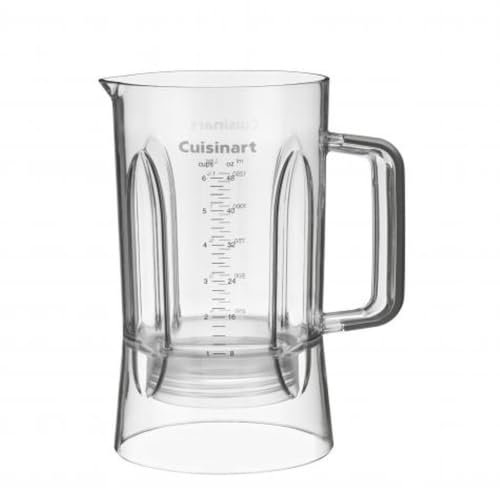


Is the Cuisinart CBT-2000 Good?
Yes, on its listed features, the CBT-2000 is a strong fit for a home that blends often. In Cuisinart CBT-2000 vs SPB-7, it offers the broader tool set. Its large jar gives more room for shared drinks. Its speed dial gives more choice than a short row of named buttons. I would favor this setup when planning frozen fruit drinks for several people. It leaves more room to adapt the process as the mix changes. That is a buying judgment, not a measured claim about how smooth a test batch became.
For a planned Sunday meal prep session, I would also value the timer and saved preset times. They could help keep a repeated recipe on track. Still, a feature-rich blender is only useful when those features match the job. For one small shake each week, this model may feel like a large toolbox for one loose screw. Cuisinart lists the original CBT-2000 as discontinued, so I would check the unit’s condition and sale terms before buying.
What Makes It Stand Out / Key Features
- Large jarThe 64-ounce Tritan plastic jar is BPA-free and has a soft-grip handle.
- Motor ratingCuisinart lists 3.5 peak horsepower. Peak power is not a continuous output rating.
- Adjustable speedA speed dial offers finer choice than fixed task buttons.
- Preset modesSmoothie, Ice Crush, Soup, and Clean modes cover several common tasks.
- Timer and memoryThe display shows a countdown, and the memory feature saves changed preset times.
- Load sensingBlendLogix responds to the load to help maintain blending speed.
My Recommendation
I would consider the CBT-2000 for frequent blends, shared drinks, and recipes that need more control. In Cuisinart CBT-2000 vs SPB-7, it is my feature-based choice for a wider range of tasks.
| Best For | Why |
|---|---|
| Homes that blend often | Presets and saved times may ease repeat tasks. |
| Shared drink batches | The larger jar offers more nominal capacity. |
| Hands-on cooks | The speed dial gives more room to adjust. |
Is the Cuisinart SPB-7 Good?
It depends on the work and the exact version for sale. The SPB-7 makes sense for a buyer who wants glass and clear task buttons. In Cuisinart CBT-2000 vs SPB-7, I would put it on the list for basic shakes and simple sauces. For a planned weeknight meal, I could see myself choosing a named mix setting rather than working through more options. That is a use case based on its controls. It is not a report from my own kitchen. I cannot claim that it matched the Hurricane Pro in a blend test.
The model details need care. Cuisinart’s current US SPB-7 page lists a 500-watt motor and a 48-ounce glass jar. Some older listings use other specs, so I would match the label and manual to the unit being sold. I would also check the jar for chips and the seal for wear on a used machine. A low price loses its shine if a leak sends breakfast across the counter. Cuisinart lists this model as discontinued too.
What Makes It Stand Out / Key Features
- Glass jarThe current US model page lists a 48-ounce glass jar; check older versions before buying.
- Motor ratingThe current US model page lists 500 watts.
- Touchpad controlsNamed controls include stir, chop, mix, puree, liquefy, pulse, and ice crush.
- Pulse controlPulse can work at the selected speed for short bursts.
- Pour spoutThe jar has a spout designed to limit drips.
- Measured lid capA removable 2-ounce cap helps measure small additions.
My Recommendation
I would consider the SPB-7 for simple recipes and a strong preference for glass. In Cuisinart CBT-2000 vs SPB-7, choose it when its condition and price make sense for light use.
| Best For | Why |
|---|---|
| Glass jar fans | It offers glass instead of Tritan plastic. |
| Occasional users | The core controls cover basic blending tasks. |
| Buyers who like task buttons | The named settings keep choices clear. |
Cuisinart CBT-2000 vs SPB-7: Side-by-Side Test
This Cuisinart CBT-2000 vs SPB-7 comparison is a desk review of listed features. No hands-on blend, noise, or durability test was done.
The scores below express my buying judgment within each category. They are not lab results. The SPB-7 values follow Cuisinart’s current US model page; check the exact unit before purchase.
Motor and Control: Which Offers More?
For Cuisinart CBT-2000 vs SPB-7, the control system gives a clearer contrast than unlike motor ratings.
| Feature | Product 1 | Product 2 |
|---|---|---|
| Listed motor rating | 3.5 peak horsepower | 500 watts on current US page |
| Speed selection | Adjustable dial | Named task buttons |
| Load sensing | BlendLogix | No equivalent listed |
⭐ CBT-2000 – 9/10 | SPB-7 – 6/10
The CBT-2000 has the edge in motor control; these ratings do not prove a measured power ratio.
Jar Size and Material: Which Fits?
Jar choice in Cuisinart CBT-2000 vs SPB-7 comes down to batch size and material preference.
| Feature | Product 1 | Product 2 |
|---|---|---|
| Listed jar capacity | 64 ounces | 48 ounces on current US page |
| Jar material | Tritan plastic | Glass |
| Main appeal | More room for shared batches | Glass for buyers who prefer it |
⭐ CBT-2000 – 9/10 | SPB-7 – 8/10
The CBT-2000 wins on capacity, while the SPB-7 wins for a firm glass preference.
Presets and Timing: Which Saves Steps?
Repeated recipes make the timing gap in Cuisinart CBT-2000 vs SPB-7 more useful.
| Feature | Product 1 | Product 2 |
|---|---|---|
| Task approach | Timed recipe presets | Named speed and function buttons |
| Countdown display | Included | Not listed |
| Saved preset times | Included | Not listed |
⭐ CBT-2000 – 9/10 | SPB-7 – 5/10
The CBT-2000 has the edge for repeat recipes that benefit from a set run time.
Daily Use: Which Feels Simpler?
More choices help some cooks, while a short set of task buttons helps others.
| Feature | Product 1 | Product 2 |
|---|---|---|
| First-use learning | More features to learn | Fewer control concepts |
| Manual adjustment | Turn the speed dial | Choose a named setting |
| Best control fit | Users who like fine adjustments | Users who like direct task labels |
⭐ CBT-2000 – 8/10 | SPB-7 – 9/10
The SPB-7 gets a small edge for simple controls, though ease of use remains personal.
Cleanup: Which Offers More Help?
Cleanup matters when the breakfast rush leaves little time at the sink.
| Feature | Product 1 | Product 2 |
|---|---|---|
| Dedicated clean mode | Included | Not listed |
| Jar care concern | Avoid damage to the plastic surface | Avoid chips and impact damage |
| Care instructions | Follow the model manual | Follow the exact version’s manual |
⭐ CBT-2000 – 9/10 | SPB-7 – 7/10
The CBT-2000 has the edge for its clean mode, though residue still needs a check.
Value: Which Is Worth Buying?
For Cuisinart CBT-2000 vs SPB-7, a fair deal depends on condition as well as features.
| Feature | Product 1 | Product 2 |
|---|---|---|
| Best value case | Frequent use of its added controls | Basic use at a suitable price |
| Original model status | Discontinued | Discontinued |
| Before purchase | Check jar, drive, parts, and sale terms | Check version, glass, seals, and sale terms |
⭐ CBT-2000 – 8/10 | SPB-7 – 7/10
The CBT-2000 offers more feature value for frequent use; no price winner can be named without live offers.
Final Verdict: Which Should You Buy?
My feature-based choice in Cuisinart CBT-2000 vs SPB-7 is the CBT-2000. Its larger jar, speed dial, and timed presets suit frequent use and shared batches. Those tools give it more room to grow with a varied recipe list.
I would choose the SPB-7 for simpler tasks and a clear preference for glass. Both original models are discontinued. Check the exact version, condition, parts, and sale terms. A sound basic blender can be a better buy than a worn premium one.