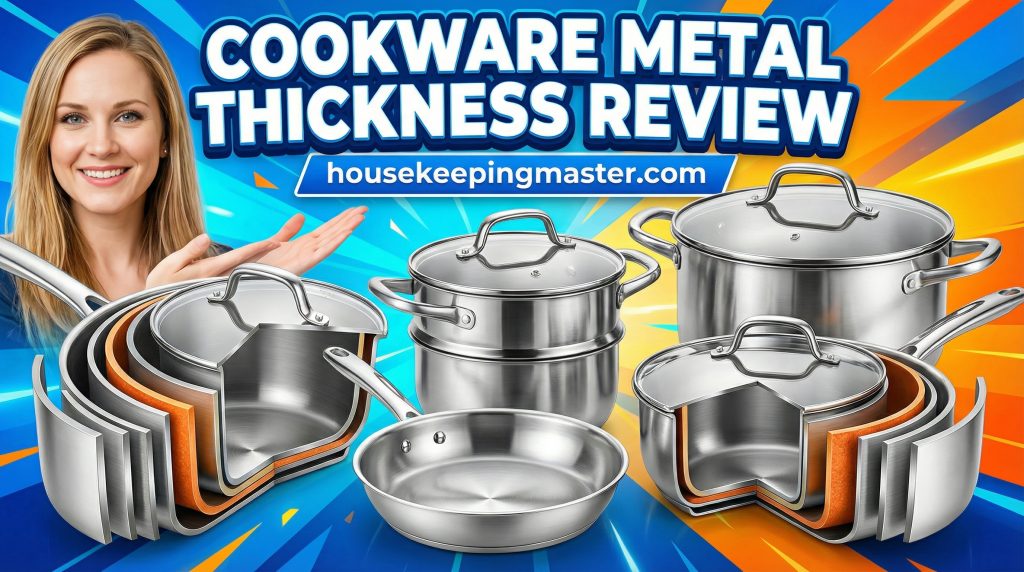
Cookware thickness affects how evenly a pan heats, how much heat it stores, how quickly it responds to burner changes, and how resistant it is to warping. Thicker cookware is not automatically better because the material, layer construction, and heat source matter just as much.
For home cooks in the United States, cookware thickness becomes noticeable when you sear a steak, fry eggs, simmer a sauce, or cook on a powerful gas, electric, or induction range. A thin pan can respond quickly but may develop stronger hot spots and lose temperature when cold food is added. A heavier pan generally provides more thermal buffering, although it can take longer to heat and cool.
Thickness should be evaluated together with thermal conductivity and construction. Stainless steel conducts heat relatively poorly compared with aluminum and copper, which is why many stainless-steel pans use an aluminum or copper core. In clad cookware, the thickness and location of the conductive core can matter more than the total thickness printed in a specification. The practical goal is not simply to buy the thickest pan, but to match the construction to the cooking task.
Source: Bing
What Does Cookware Thickness Mean?
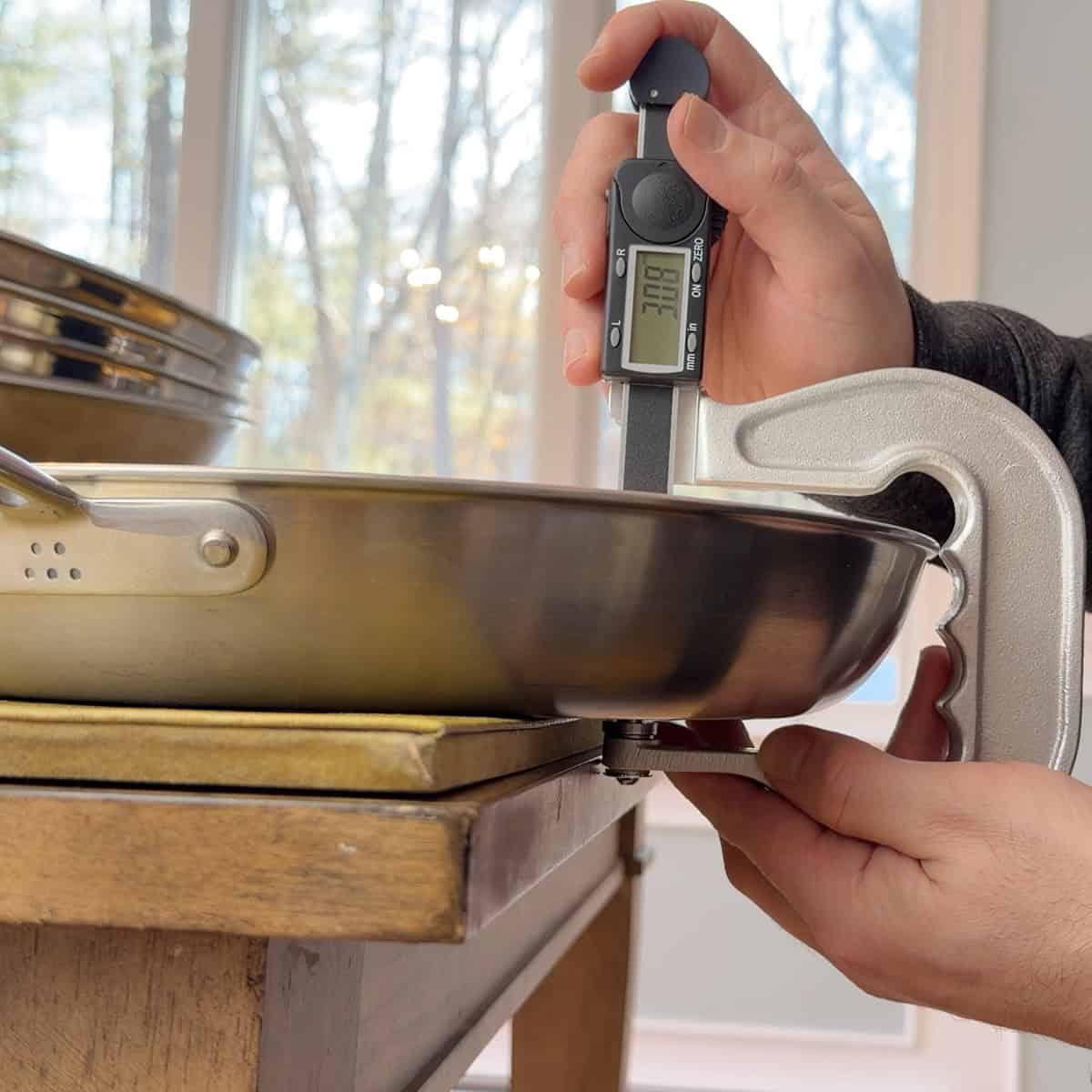
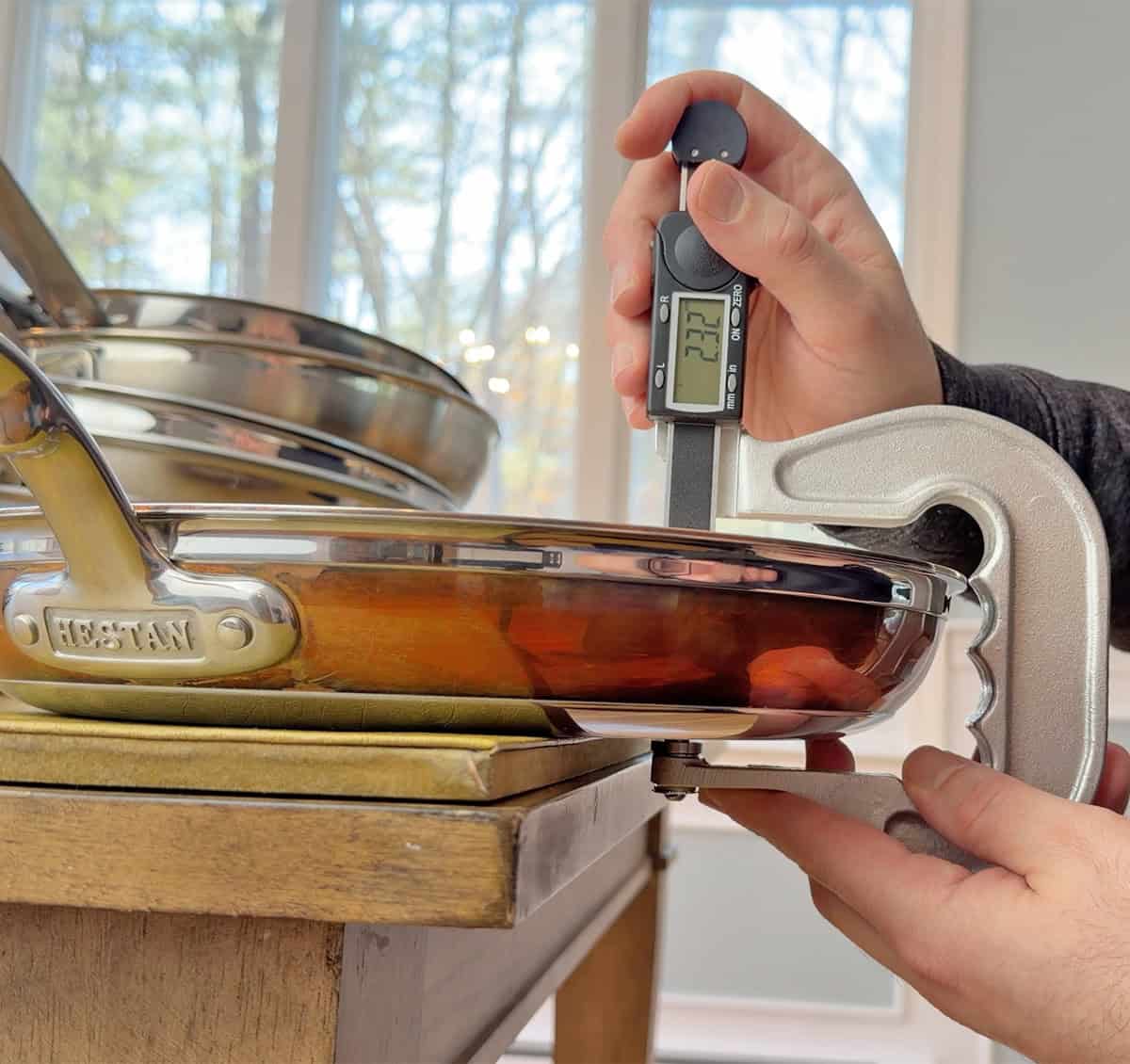
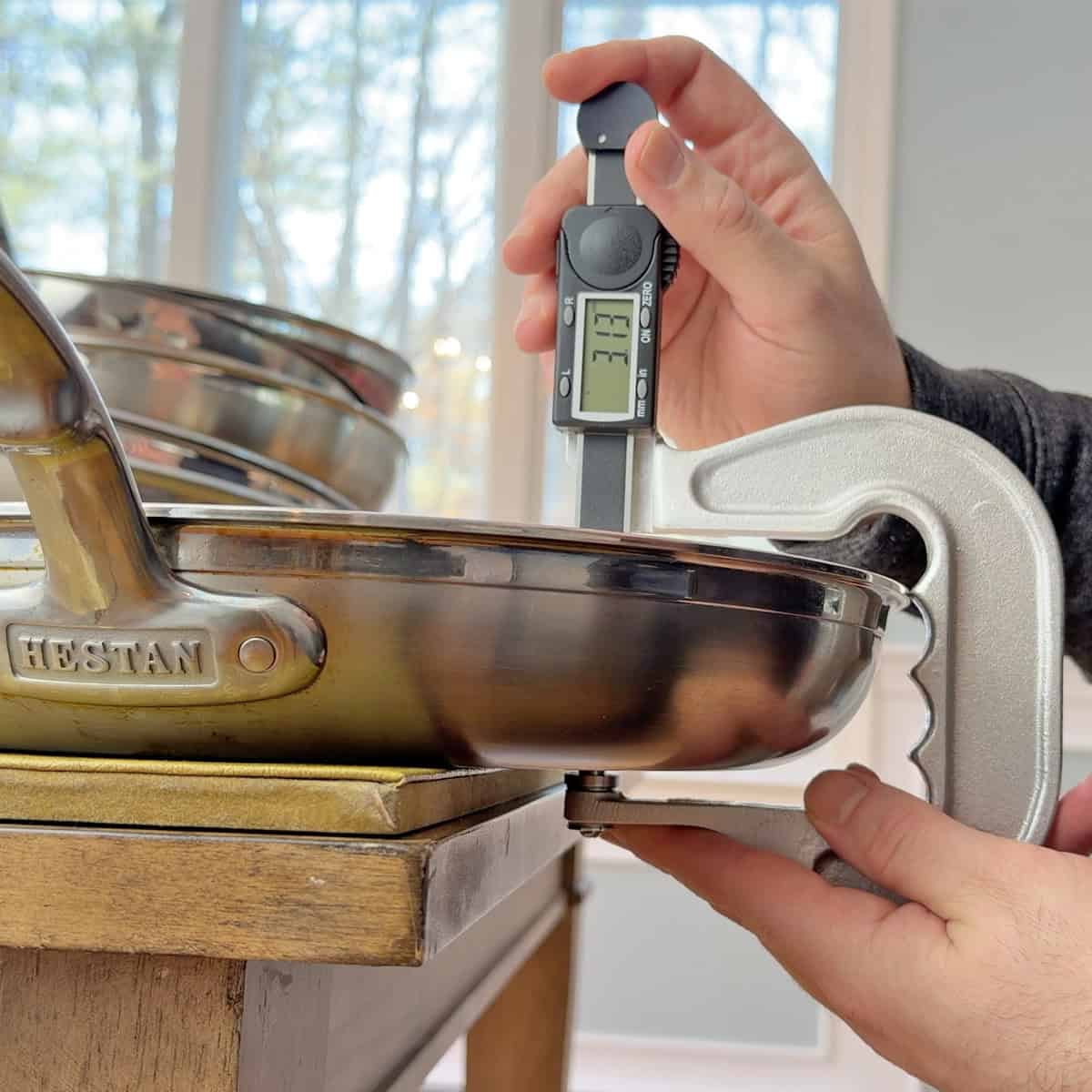
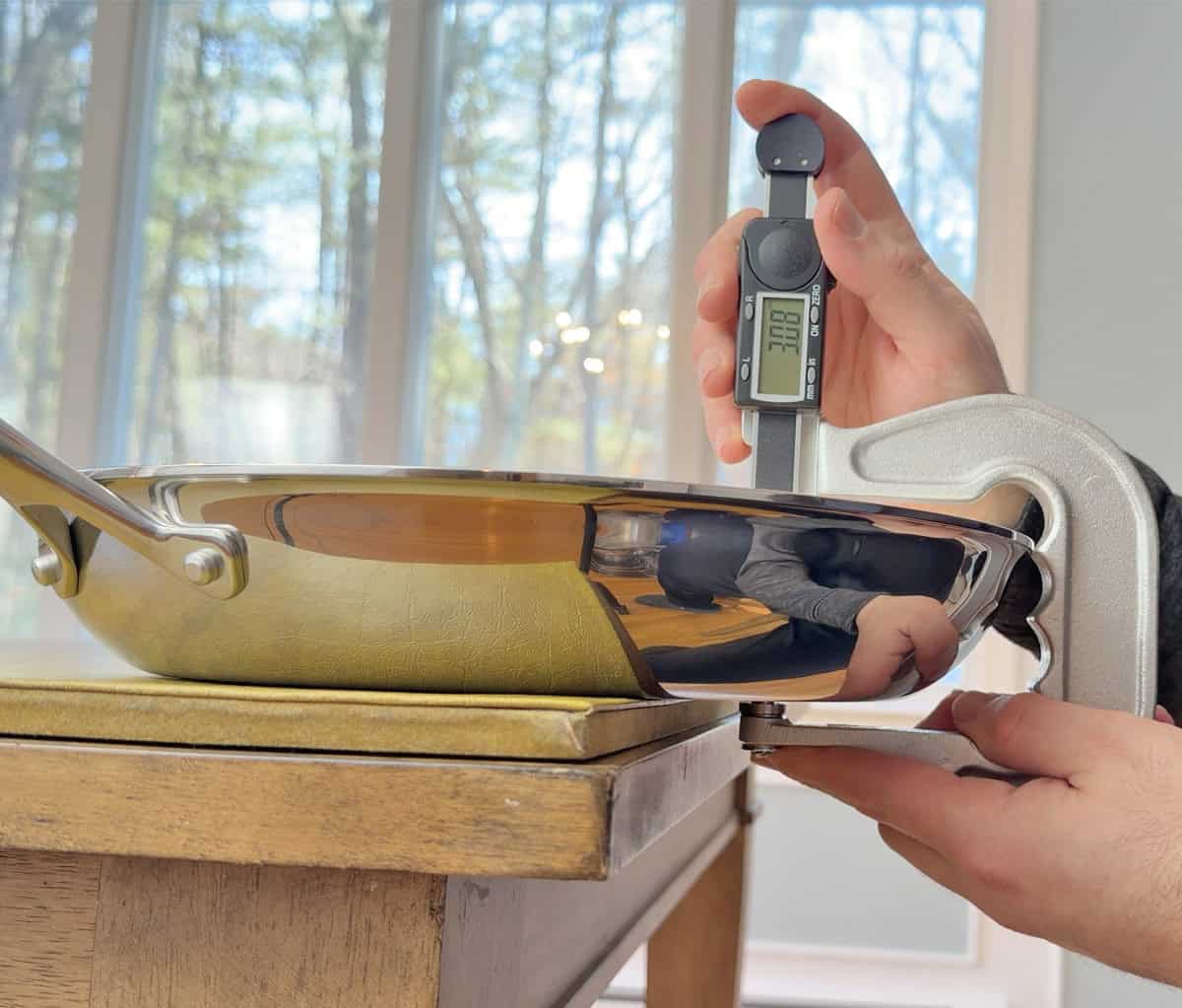
Cookware thickness refers to the physical thickness of the metal or combined metal layers that make up a pot or pan. Manufacturers may describe it in millimeters, inches, gauge, or by construction terms such as tri-ply and five-ply. These measurements are not interchangeable without knowing exactly which part of the cookware they describe.
A single-layer aluminum or stainless-steel pan has a relatively straightforward thickness specification. A clad pan is different because several metals may be bonded together. For example, a stainless-steel pan can contain stainless steel on the cooking surface, a thicker aluminum layer for heat spreading, and another metal layer on the outside. The total thickness therefore does not tell the entire thermal story.
Thickness also varies within a single piece of cookware. A pan can have thin walls but a thick encapsulated base, while fully clad cookware carries multiple layers through the side walls as well as the bottom.
Source: Bing
Total thickness
The combined thickness of all bonded layers. Useful for understanding construction, but not sufficient for predicting heat performance.
Core thickness
The thickness of the heat-conductive layer, such as aluminum or copper, inside clad cookware. This can be especially important for heat spreading.
Wall thickness
The thickness of the pan sides. It contributes to structural strength and, in fully clad cookware, can also affect heat movement up the sides.
Why Thickness Changes Cooking Performance
Thickness changes cooking performance mainly through two related effects: heat distribution and thermal mass. Heat distribution describes how readily heat moves through the cookware, while thermal mass describes how much energy the cookware can absorb before its temperature changes substantially.
A thicker piece of the same material generally contains more material across the heated area. That added mass requires more energy to produce the same temperature increase, so the pan tends to resist sudden temperature changes. This can be useful when a cold steak, vegetables, or other food is placed into a hot pan.
At the same time, thicker cookware is not necessarily faster or more evenly heated. Thermal conductivity determines how readily heat travels through the material, while the geometry and burner pattern determine where heat enters the pan. A thick stainless-steel layer does not spread heat in the same way as an equally thick aluminum or copper layer.
Source: Bing
More thermal buffering
A heavier pan can resist rapid temperature drops when relatively cool food is added.
Slower response
More thermal mass generally means the pan takes longer to change temperature after the heat setting is adjusted.
Potentially better stability
When the construction is appropriate, added mass can make cooking temperatures less sensitive to short-term disturbances.
Not automatically more even
Evenness depends strongly on thermal conductivity and where conductive material is positioned.
Thin vs. Thick Cookware: What Changes in the Kitchen?
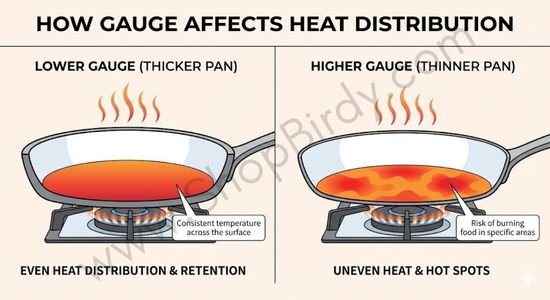
The practical difference between thin and thick cookware is easiest to see when the pan experiences uneven heating or a large temperature change. Thin cookware typically requires less energy to heat, while thicker cookware generally provides greater thermal buffering.
Neither characteristic is universally better. A cook making a quick omelet may value responsive temperature changes, while someone searing several steaks may prefer a pan that holds its temperature when food is added. The ideal balance depends on the food, burner, pan material, and cooking technique.
Source: Bing
Thin cookware
Usually heats and cools relatively quickly, but can be more sensitive to burner hot spots and cold food.
Thick cookware
Usually has greater thermal mass and can provide more temperature stability, but often takes longer to preheat and cool.
Thick conductive cookware
A substantial aluminum or copper core can combine thermal buffering with effective lateral heat spreading.
Heavy but poorly conductive cookware
Extra mass can improve heat retention without necessarily eliminating localized hot spots.
How thickness affects searing
Searing benefits from a cooking surface that can remain hot when relatively cool food contacts it. A heavier pan can lose a smaller proportion of its stored thermal energy during that brief contact, although the actual result also depends on preheating, food quantity, burner output, and pan material.
Best practical approach
Preheat the cookware appropriately, avoid overcrowding the surface, and choose a pan with enough thermal mass for the amount of food being cooked.
How thickness affects delicate cooking
Delicate foods and sauces can benefit from predictable heat behavior. A pan with substantial thermal mass can be slower to respond when the burner is reduced, which may be helpful for stability but inconvenient when rapid control is required.
Control matters
For recipes requiring frequent heat adjustments, consider the entire construction rather than assuming that maximum thickness is preferable.
Thickness and Heat Distribution Are Not the Same Thing
A common misconception is that a thicker pan will always heat more evenly. Thickness can contribute to heat spreading, but the material carrying that heat is critical. Aluminum and copper conduct heat much more effectively than stainless steel, so a thinner conductive core can sometimes spread heat more effectively than a thicker layer of a poorer conductor.
This is one reason manufacturers use multi-layer cookware. A stainless-steel exterior can provide durability and a suitable food-contact surface, while aluminum or copper inside the construction moves heat more efficiently. In clad cookware, the thickness, conductivity, and coverage of the conductive layer all affect the final behavior.
Burner size also matters. If a small burner heats the center of a wide pan, the center may receive much more energy than the outer area. A conductive layer can redistribute some of that energy toward cooler areas, but cookware cannot completely overcome an extreme mismatch between burner and pan size.
Source: Bing
Material
Thermal conductivity determines how readily heat moves through the cookware.
Core thickness
A thicker conductive core provides more conductive material for lateral heat movement and adds thermal mass.
Core coverage
A base-only disc and a fully clad construction distribute heat through different parts of the cookware.
Heat source
Gas flames, electric elements, and induction zones transfer energy to cookware in different ways and may produce different temperature patterns.
Why clad cookware uses multiple metals
Clad cookware combines metals because each material offers different properties. Stainless steel is mechanically durable and relatively resistant to corrosion, while aluminum and copper provide substantially higher thermal conductivity. A conductive core can therefore improve heat distribution without requiring the cooking surface itself to be made from aluminum or copper.
Stainless steel
Useful for a durable cooking surface but comparatively poor at conducting heat.
Aluminum
A highly conductive and relatively lightweight core material commonly used in multi-layer cookware.
Copper
A very highly conductive material that can provide rapid heat spreading and responsiveness, although copper cookware is often lined or clad.
How Thickness Affects Different Cookware Materials
Thickness has a different practical meaning for stainless steel, aluminum, copper, carbon steel, and cast iron because each material has different thermal and mechanical properties. Comparing millimeters across different materials without considering conductivity and density can therefore be misleading.
The most useful comparison is construction-to-construction rather than thickness-to-thickness. A thin aluminum pan, a thick stainless-steel pan, and a cast-iron skillet can all behave differently even if their measured thicknesses appear similar.
Source: Bing
Stainless steel
Thickness can add strength and thermal mass, but stainless steel alone is not a highly conductive cookware material. A conductive aluminum or copper core can significantly change its heating behavior.
Aluminum
Because aluminum conducts heat efficiently, thickness can provide a useful combination of heat spreading, thermal mass, and structural rigidity.
Copper
Copper is highly conductive, so it can provide rapid heat spreading even without extremely thick sections. Thickness also contributes to durability and thermal mass.
Carbon steel
Thicker carbon steel generally stores more heat and can be more resistant to deformation, while thinner carbon steel responds more quickly.
Cast iron
Cast iron has high thermal mass but relatively low thermal conductivity compared with aluminum and copper. Its substantial mass helps it retain heat once thoroughly heated.
Does Thicker Cookware Prevent Warping?
Thicker construction can improve resistance to dents and deformation, but thickness does not make cookware immune to warping. Warping is strongly related to uneven heating, thermal expansion, construction, material properties, and how quickly temperature changes occur.
Rapidly heating one area of a cold pan can create temperature differences across the metal. Different areas then expand by different amounts, creating mechanical stress. Repeated severe thermal cycling can contribute to permanent deformation, particularly in thinner or less rigid cookware.
The safest practice is to follow the cookware manufacturer’s heating and cooling guidance. Avoid intentionally shocking extremely hot cookware with cold water unless the manufacturer specifically permits it, and avoid heating an empty pan at unnecessarily high temperatures.
Source: Bing
Thickness helps
More material can increase structural rigidity and resistance to deformation.
Construction matters
Layer bonding, material choice, base design, and geometry also influence resistance to distortion.
Heat changes matter
Sudden and uneven heating can create thermal stresses regardless of whether cookware is marketed as heavy-duty.
How to Choose the Right Cookware Thickness
Choose cookware thickness based on the cooking task, heat source, material, and construction rather than using a single thickness number as a universal target. For most home kitchens, a well-designed pan with good heat-spreading material and enough mass for the intended food is more useful than simply selecting the heaviest option.
When comparing cookware, look beyond the words tri-ply, five-ply, heavy-duty, or professional. Ask what metals are used, how thick the conductive core is, whether the construction is fully clad or base-only, and whether the pan is designed for your cooktop.
Source: Bing
For high-heat searing
Favor cookware with enough thermal mass to limit temperature drops when food is added, while also considering the conductivity and coverage of the cooking surface.
For sauces and controlled cooking
Look for predictable heat distribution and consider whether the pan responds quickly enough for frequent burner adjustments.
For everyday stainless steel
A multi-layer design with an aluminum or copper core can offer a more useful combination of durability and heat distribution than thin stainless steel alone.
For lightweight cooking
Thinner or lighter cookware can be easier to handle and can respond quickly, but pay attention to hot spots and structural rigidity.
For induction
Check the manufacturer’s induction compatibility and construction details. Thickness by itself does not determine whether a pan will work on an induction cooktop.
A practical comparison framework
If a manufacturer provides layer-by-layer specifications, compare the material and thickness of each layer instead of relying only on total gauge. If those details are unavailable, evaluate the cookware through its construction, weight, intended heat source, warranty information, and documented specifications rather than assuming that a larger thickness number means better cooking performance.
First
Identify the cooking technique you use most often.
Second
Check the cookware material and conductive core.
Third
Check whether the construction is fully clad or has a separate base.
Fourth
Consider the pan’s weight and how much thermal mass you actually need.
Fifth
Confirm compatibility with your gas, electric, ceramic, or induction cooktop.
Common Mistakes When Comparing Cookware Thickness
The biggest mistake is treating total thickness as a complete measure of cooking performance. Two pans with the same overall thickness can contain very different materials and layer arrangements, leading to different heating behavior.
Another mistake is assuming that heavier cookware will always cook better. More mass can improve temperature stability, but it can also make a pan slower to heat and less responsive to burner adjustments. The best construction depends on the job.
Correction: Nonstick behavior depends primarily on the cooking surface and how the cookware is used, not simply on metal thickness.
Mistake: Ignoring response time
Correction: Remember that greater thermal mass can stabilize temperature but may also make rapid heat adjustments slower.
Frequently Asked Questions
Q
Is thicker cookware always better?
No. Thicker cookware generally provides more thermal mass and can improve structural rigidity, but it may heat and cool more slowly. Material conductivity and construction can matter more for even heating, so the best thickness depends on the cooking task.
Q
Does a thicker pan cook food more evenly?
Not necessarily. A thicker layer of highly conductive aluminum or copper can spread heat effectively, while thick stainless steel alone may not distribute heat as efficiently. The size and location of the conductive core also matter.
Q
What is the advantage of a thick cookware base?
A thick base can provide greater thermal mass and, when it contains a conductive material, can help spread heat away from the hottest area above the burner. This can reduce temperature differences across the cooking surface.
Q
Does cookware thickness affect cooking time?
It can. Thicker cookware usually contains more material that must be heated, which can increase preheating time. However, cooking time also depends on the material, heat source, pan size, food quantity, starting temperature, and heat-transfer conditions.
Q
How can I tell whether a multi-ply pan is actually well constructed?
Look for documented information about the metals and their layer arrangement, not just the number of plies. A useful specification identifies the conductive core, whether the layers extend through the sides, and the cookware’s intended heat sources. When detailed layer thickness is unavailable, avoid assuming that a higher ply count automatically means better performance.
✦ Wrapping Up
Conclusion
Cookware thickness affects cooking by changing thermal mass, heat response, structural rigidity, and, when paired with an appropriate conductive material, heat distribution. A thicker pan can hold its temperature more effectively when cold food is added, but it may also require more time to heat and respond more slowly to burner changes.
The most useful way to evaluate cookware is to consider thickness as one part of the entire construction. Material, conductive core, layer placement, pan geometry, burner size, and cooking technique all influence the final result. For everyday U.S. home cooking, a well-designed pan that balances conductivity and thermal mass is usually more practical than choosing cookware solely because it is thick or heavy.
💡 Key Takeaway
When comparing cookware, do not ask only how thick the pan is. Ask what the layers are made of, where the conductive material is located, how much thermal mass you need, and whether the construction matches your cooktop and cooking style.
Learn what kitchen items are worth spending money on with expert picks, budget-friendly swaps, and tips to shop smarter for lasting cookware and tools.
Understand sensor microwave meaning and learn how sensor cooking prevents overcooking, saves time, and improves meals. Simple tips for smarter microwave use.
Learn the best methods for Kitchen Knife Cleaning & Hand Washing. Discover safe washing steps, drying tips, common mistakes, food safety advice, and ways to protect your blades.