Deep Frying Temperature & Safety: Safe Oil Temperatures, Cooking Tips, and Fire Prevention
Deep frying can give food a crisp crust and a tender center, but hot oil needs respect. The oil can reach temperatures far above the boiling point of water. A small mistake, such as adding wet food or filling the fryer too high, can cause a fast and dangerous reaction.
Good Deep Frying Temperature & Safety starts with temperature control. Oil that is too cool can make food greasy and pale. Oil that is too hot can burn the outside before the center cooks. In a home kitchen, a simple thermometer, a stable fryer, and good habits can prevent many common problems.
The goal is not just to make fried food crisp. Safe frying also means preventing burns and fires, keeping raw food at safe temperatures, and handling used oil with care. This guide explains the key temperatures, tools, methods, and safety steps for U.S. home cooks and food-service settings.
What Is the Best Temperature for Deep Frying?
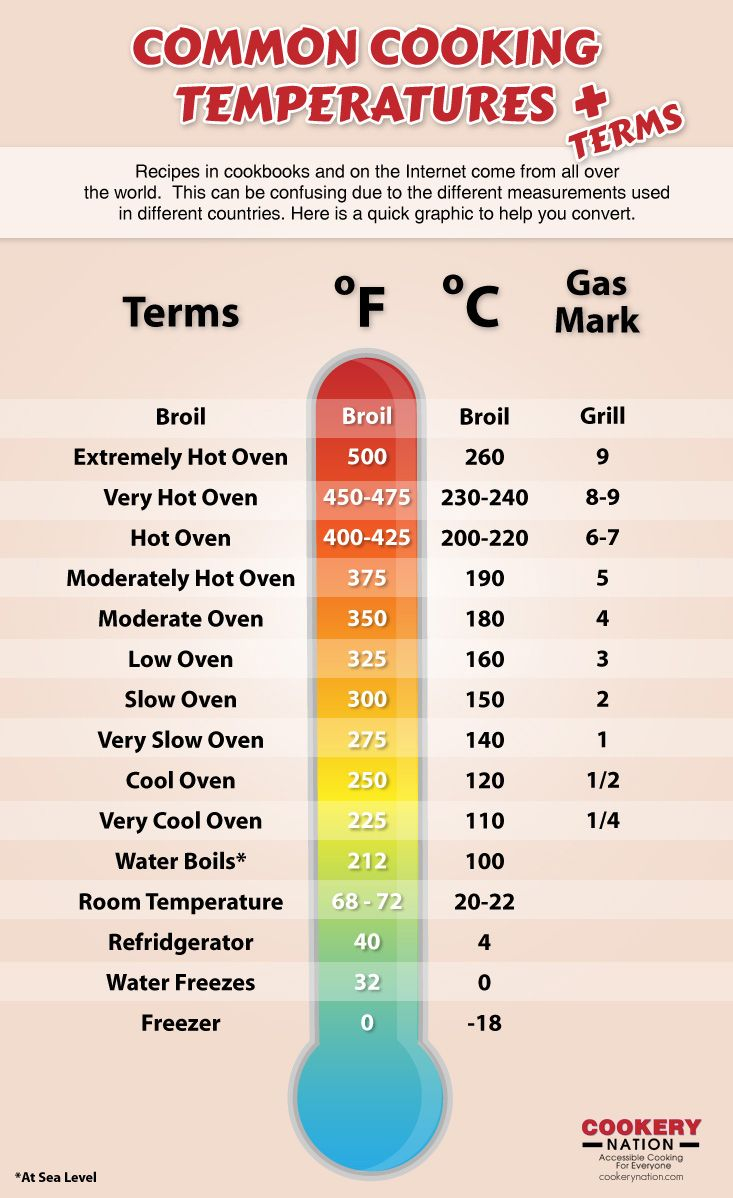
For many fried foods, a useful starting range is **350°F to 375°F**. This range is hot enough to form a crisp surface while allowing the food to cook through at a steady rate. The exact setting still depends on the food, its size, and the type of oil.
Temperature drops when cold food enters the oil. This is normal. A fryer with strong heat recovery can bring the oil back to the target range faster than a small pot on a home stove.
Deep Frying Temperature & Safety depends on controlling these changes. Do not judge oil temperature by smoke or by how fast food bubbles. Use a reliable thermometer and adjust the heat as needed.

- ✦ 325°F to 350°F
Useful for some delicate foods and items that need more time to cook without darkening too fast.
- ✦ 350°F to 375°F
A common working range for foods such as French fries, chicken pieces, fish, and many breaded foods.
- ✦ Above 375°F
Higher heat can brown food very quickly and may increase the risk of burnt food, smoke, and oil degradation.
Why Oil Temperature Matters
Hot oil quickly removes moisture from the food surface. That helps create the crisp texture people expect from fried food. If the oil lacks enough heat, moisture leaves more slowly and the food may absorb more oil.
Very high heat creates a different problem. The outside may become dark before the center reaches a safe and desirable cooking state. Temperature control therefore affects both quality and safety.
- ✦ Too cool
Food can become greasy, soft, and slow to brown.
- ✦ Too hot
Food can burn on the outside, while the center remains undercooked.
- ✦ Well controlled
Food can brown evenly while the center cooks at a steady pace.
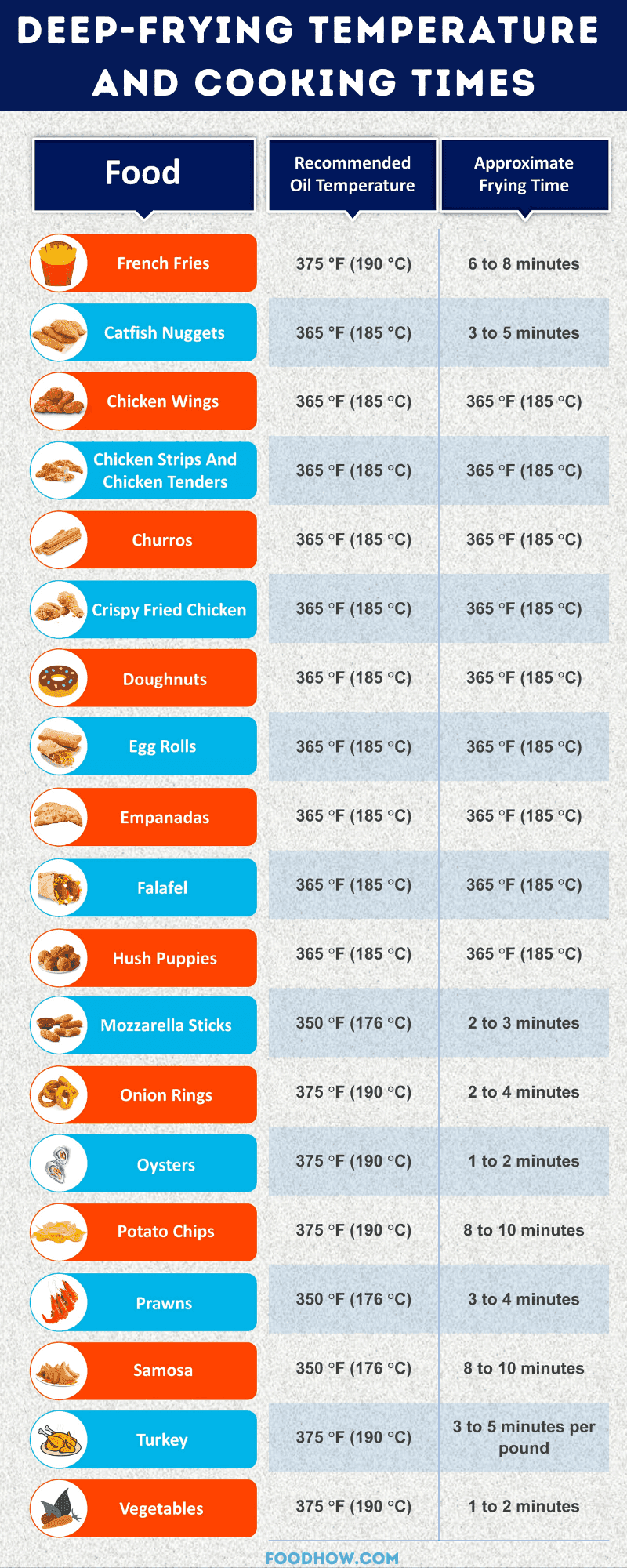
Deep Frying Temperature Guide for Common Foods
Different foods need different frying methods. A thin onion ring cooks much faster than a large piece of chicken. Frozen foods also behave differently from fresh foods because they can cause a larger temperature drop when added to the oil.
Use cooking times as a guide, not as a guarantee. Food size, thickness, coating, starting temperature, oil volume, and fryer power all change the result. For meat and poultry, always check the internal temperature with a food thermometer.
A temperature chart can help you choose a starting point, but it should not replace the instructions for your recipe or appliance.
- ✦ French fries
Many cooks use a lower-temperature first cook followed by a hotter second cook. This helps create a soft center and crisp exterior.
- ✦ Chicken
A common frying range is around 325°F to 350°F. Thick pieces need enough time for the center to reach a safe internal temperature.
- ✦ Fish
Many breaded or battered fish recipes work well around 350°F to 375°F. Thin pieces cook faster than thick fillets.
- ✦ Onion rings
A range near 350°F to 375°F often works well for crisp breaded or battered onion rings.
- ✦ Donuts
Many donut recipes use a lower range near 350°F to 375°F so the outside does not brown too quickly.
- ✦ Frozen foods
Follow the package or recipe instructions. Add frozen items carefully because ice and hot oil can cause strong bubbling and splatter.
Why Cooking Time Is Not Enough
A recipe may say to fry chicken for a set number of minutes, but that time assumes a certain food size and starting temperature. A large piece can need much longer than a small piece. A crowded fryer can also lower the oil temperature and extend cooking time.
For poultry, use a food thermometer to verify the thickest part has reached **165°F**. Avoid touching bone when taking the reading, since it can make the measurement less useful.
- ✦ Check the center
Insert the thermometer into the thickest part of the food.
- ✦ Avoid relying on color
A brown crust does not prove that meat or poultry has reached a safe internal temperature.
How to Measure Deep Frying Oil Temperature
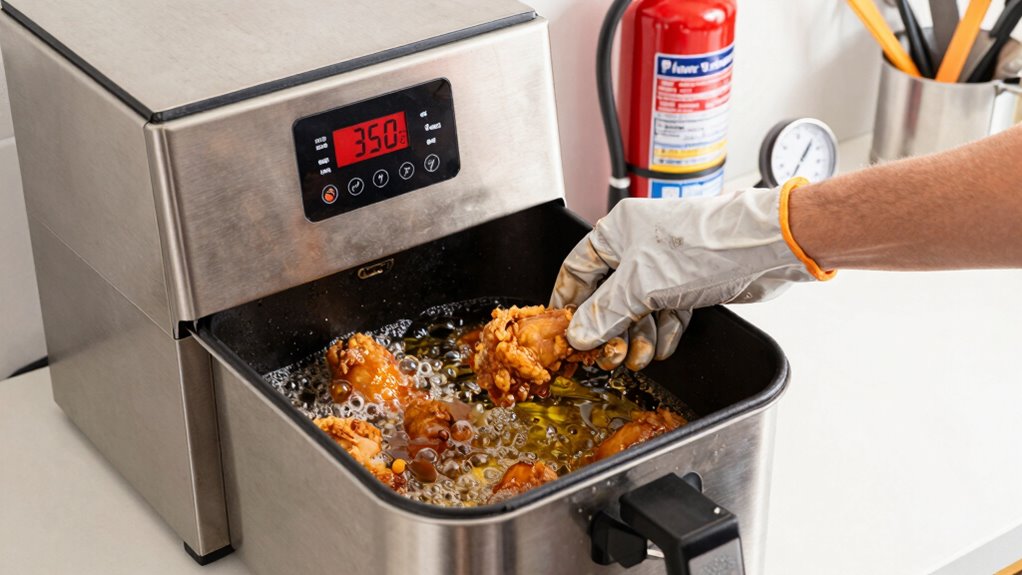
A thermometer is one of the most useful tools for Deep Frying Temperature & Safety. A deep-fry thermometer can clip to the side of a pot, while a digital thermometer can give a quick reading. Check that the thermometer is rated for the temperatures used in frying.
Place the sensing area in the oil without letting it touch the bottom or side of the pot. The metal of the pot can give a reading that does not represent the oil itself.
Check the oil before adding food and again after adding a batch. If the temperature falls too much, wait for it to recover before adding more food.
- ✦ Use a suitable thermometer
Choose a thermometer designed for high-temperature cooking and follow its instructions.
- ✦ Measure the oil
Keep the probe in the oil rather than against the cookware.
- ✦ Watch recovery
Give the oil time to return to the desired range before adding another batch.
- ✦ Do not use smoke as a guide
Smoking oil is not a safe target temperature. Different oils have different smoke points, and visible smoke means the oil is overheating.
How to Keep Oil Temperature Stable
The easiest way to stabilize oil is to avoid large batches. Adding too much cold food at once can cause a sharp temperature drop. The fryer then works harder and the food may cook unevenly.
Use a pot or fryer that is large enough for the amount of food you plan to cook. Keep the oil level within the appliance’s marked limits. Never fill a fryer based only on how much oil seems to fit.
- ✦ Fry in small batches
Leave enough space for the oil to circulate around the food.
- ✦ Preheat first
Bring the oil to the recipe’s target temperature before adding food.
- ✦ Let the oil recover
Wait for the temperature to return to the target range between batches.
Deep Frying Safety Rules Every Cook Should Follow
Hot oil can cause severe burns and can start a kitchen fire if it overheats. Most safe frying habits are simple: keep water away from hot oil, stay near the fryer, and control the amount of oil in the pot.
Never leave a pot of heating oil unattended. If you need to leave the kitchen, turn off the heat and deal with the oil only after it has cooled to a safe temperature.
Deep Frying Temperature & Safety also means preparing before you start. Keep tools close, clear the cooking area, and know where your pan lid or other appropriate fire-control equipment is before heating the oil.

- ✦ Keep water away
Water can turn into steam almost instantly when it contacts hot oil and can cause violent splashing.
- ✦ Dry food well
Pat food dry when the recipe allows. Remove excess surface moisture before placing food near hot oil.
- ✦ Do not overfill
Use the fill line on an electric fryer or follow the cookware and recipe guidance for oil depth.
- ✦ Stay nearby
Never walk away from heating oil. A small temperature problem can become a fire very quickly.
- ✦ Lower food slowly
Use tongs, a fryer basket, or another suitable tool and lower food with care to reduce splashing.
- ✦ Keep handles clear
Position pot handles so they do not hang over the edge where they can be hit or pulled.
What to Do if Deep Frying Oil Catches Fire
If cooking oil catches fire, **do not use water**. Water can spread burning oil and make the fire much worse.
If it is safe to do so, turn off the heat. For a small pan fire, carefully slide a metal lid over the pan to cut off the oxygen. Keep the lid in place and do not move the pan.
If the fire does not go out quickly or you cannot safely control it, leave the area and call 911. Follow your local fire department’s guidance and use a fire extinguisher only when it is appropriate and you know how to use it safely.
- ✦ Never pour water on an oil fire
Water can cause burning oil to spread rapidly.
- ✦ Do not move a burning pan
Moving it can spread flames and burning oil.
- ✦ Get out when needed
If the fire grows or you cannot control it safely, evacuate and call 911.
Why Wet Food Causes Dangerous Oil Splatter
Water and hot oil do not mix well. When water reaches very hot oil, it can turn into steam at once. The rapid expansion can push hot oil out of the pan and onto nearby surfaces or skin.
Frozen foods can also cause heavy bubbling because ice contains water. This does not mean frozen foods cannot be fried, but they must be handled with care and added according to the product or recipe instructions.
For better Deep Frying Temperature & Safety, prepare food before the oil is hot. Dry surfaces when appropriate, use tools that keep your hands away from the oil, and avoid dropping food into the fryer.

- ✦ Pat food dry
Use paper towels when suitable to remove excess surface moisture before frying.
- ✦ Handle frozen food carefully
Follow package directions and lower frozen items slowly into the oil.
- ✦ Avoid dropping food
Dropping food from above can create a sudden splash.
- ✦ Keep the area dry
Do not place wet utensils, wet hands, or wet containers near hot oil.
How to Reduce Splatter
Use long-handled tongs or a fryer basket when suitable. Lower food slowly and keep your face and hands away from the oil surface.
Do not shake wet food over a pot of hot oil. Prepare the food first, then transfer it carefully. A stable work area also reduces accidental spills.
- ✦ Lower food from the side
Place food into the oil with control instead of dropping it from above.
- ✦ Use a splash guard when suitable
A guard can help contain small splashes while still allowing steam to escape.
Choosing and Managing Cooking Oil
The oil you choose affects flavor, frying performance, and how well the oil handles heat. Common frying oils include canola, peanut, soybean, sunflower, and other refined vegetable oils. Always consider the recipe, allergies, flavor, and the manufacturer’s guidance.
Do not heat oil until it smokes. Smoke is a sign that the oil has become too hot. Repeated overheating also damages oil and can create unpleasant flavors.
Good Deep Frying Temperature & Safety includes proper oil storage and disposal. Let used oil cool before handling it, strain it when appropriate, and store it in a clean, closed container if you plan to reuse it. Do not pour cooking oil down a household drain.
- ✦ Choose oil for the task
Use an oil that suits the recipe and intended cooking temperature.
- ✦ Watch for smoke
If oil begins to smoke, reduce or turn off the heat and let it cool safely.
- ✦ Filter when appropriate
Straining cooled oil can remove food particles that may burn during later use.
- ✦ Discard degraded oil
Oil that smells rancid, looks unusually dark, foams excessively, or behaves poorly should not be kept for further cooking.
- ✦ Dispose of oil correctly
Cool the oil and follow local waste rules. Do not pour large amounts of cooking oil into a sink or toilet.
How Many Times Can You Reuse Frying Oil?
There is no single safe number of uses that applies to every oil and every fryer. Oil life depends on temperature, food type, cooking time, filtration, storage, and how much food debris enters the oil.
Instead of counting uses alone, inspect the oil. A strong off smell, excessive darkening, persistent foam, or a noticeable change in frying behavior can signal that it is time to replace it.
- ✦ Food particles
Burned crumbs can speed oil breakdown and create bitter flavors.
- ✦ Heat exposure
Repeated high heat can shorten the useful life of frying oil.
- ✦ Storage
Keep reusable oil in a clean, sealed container away from heat and light.
How to Deep Fry Safely at Home
A safe home frying routine starts before the burner turns on. Read the recipe, prepare the food, check the fryer or pot, and keep the work area clear. Have the tools you need within reach so you do not need to walk away while oil is heating.
Once the oil reaches the target temperature, add food in small batches. Watch the temperature as you cook and adjust the heat so the oil stays near the recipe’s target range.
After cooking, remove the food with a basket or suitable utensil and place it on a rack or paper towels as directed by the recipe. Turn off the heat before leaving the cooking area and let the oil cool fully before you handle or store it.

- ✦ 1. Prepare first
Have the food, thermometer, tools, and heat-safe landing area ready before heating the oil.
- ✦ 2. Check the oil level
Stay within the appliance’s fill marks or the safe amount recommended for your cookware.
- ✦ 3. Preheat carefully
Bring the oil to the recipe’s target temperature without overheating it.
- ✦ 4. Add food slowly
Lower food with control to reduce splashing and sudden oil movement.
- ✦ 5. Monitor temperature
Check the oil during frying and allow it to recover between batches.
- ✦ 6. Verify food safety
Use a food thermometer for meat and poultry instead of relying only on color or cooking time.
- ✦ 7. Cool before handling oil
Turn off the heat and wait until the oil is cool enough to handle safely before filtering or storing it.
Deep Fryer Safety Compared With Pot Frying
An electric deep fryer can make temperature control easier because many models have built-in thermostats and fill lines. A pot on a stove can also work, but it demands close attention to heat, oil depth, and temperature.
Neither method is automatically safe. A built-in thermostat does not remove the need to follow the appliance manual. With either method, keep water away, avoid overfilling, and stay present while the oil is hot.
- ✦ Electric fryer
Often provides a built-in temperature setting and basket, which can simplify routine frying.
- ✦ Stovetop pot
Offers flexibility but requires closer monitoring of oil temperature and heat.
- ✦ Both methods
Require safe oil levels, dry food handling, temperature control, and constant attention.
Common Deep Frying Mistakes and How to Avoid Them
Many frying problems come from a few simple mistakes. Cooks often add too much food at once, guess the oil temperature, or leave the fryer unattended. These errors can affect both food quality and kitchen safety.
Deep Frying Temperature & Safety becomes much easier when you build a repeatable routine. Measure the oil, control batch size, keep food as dry as the recipe allows, and monitor the cooking process from start to finish.
- ✦ Guessing the oil temperature
Use a thermometer instead of relying on bubbles, color, or sound.
- ✦ Overcrowding the fryer
Too much food can drop the oil temperature and prevent even cooking.
- ✦ Using wet utensils
Water can cause hot oil to splatter.
- ✦ Overheating empty oil
Do not leave oil heating while doing another task.
- ✦ Frying very large pieces
Large foods can brown before their centers cook. Adjust the method and verify internal temperature when needed.
- ✦ Pouring hot oil into a container
Wait until the oil has cooled to a safe handling temperature and use a heat-safe container.
Why Overcrowding Causes Problems
When too much cold food enters hot oil, the temperature can fall sharply. The food then spends more time in the oil, which can lead to a greasy surface and uneven browning.
Leaving space around the food helps hot oil circulate. Smaller batches often produce a more even crust and make temperature control easier.
- ✦ Better heat recovery
A smaller batch lets the oil return to its target temperature more quickly.
- ✦ More even cooking
Space around the food helps oil reach more of its surface.
Deep Frying Safety for Turkey and Large Foods
Large-batch frying deserves extra care. Whole turkey frying is especially risky because a large bird contains a great deal of moisture and can displace a large amount of oil. Outdoor turkey frying should follow the fryer manufacturer’s instructions and recognized fire-safety guidance.
Never place a wet or partially frozen turkey into hot oil. Ice and water can cause a sudden and dangerous eruption of hot oil. Measure the oil level with the turkey and fryer cold, using the method recommended by the fryer manufacturer.
Deep Frying Temperature & Safety matters even more with large foods because the volume of hot oil can make a fire or spill harder to control. Keep the fryer outdoors in a suitable open area, away from buildings and combustible materials, and never leave it unattended.
- ✦ Fully thaw the turkey
Follow safe thawing guidance before frying. A frozen or partly frozen turkey can cause violent bubbling and oil overflow.
- ✦ Measure oil while cold
Use the manufacturer’s recommended method to prevent overfilling and overflow.
- ✦ Keep the fryer outdoors
Use the fryer only where the manufacturer allows it and keep it away from structures and combustible materials.
- ✦ Stay with the fryer
Never leave a large outdoor fryer operating without supervision.
- ✦ Plan for emergencies
Know how to shut off the heat and how to respond if oil catches fire before you begin.
Why Large Foods Need Extra Planning
Large foods can displace enough oil to cause an overflow if the fryer is filled too high. Overflowing oil can reach a burner or heating element and create a fire risk.
The food also needs enough time to cook through. Use the recipe and equipment instructions, then verify food temperature when appropriate.
- ✦ Oil displacement
A large food item takes up space and can force oil above the safe level.
- ✦ Moisture
Water inside or on the surface of the food can react strongly with hot oil.
- ✦ Heat control
Large fryers need stable heat and careful monitoring throughout the cook.
Food Safety After Deep Frying
Safe frying does not end when food leaves the oil. Fried food can still become unsafe if it sits at room temperature for too long. Keep cooked food hot when serving it soon, or refrigerate it promptly when it will not be eaten.
For leftovers, use shallow containers when practical so food cools more quickly. Refrigerate perishable food within two hours, or within one hour when the surrounding temperature is above 90°F.
Deep Frying Temperature & Safety includes cross-contamination control. Use clean plates and utensils for cooked food rather than placing cooked items back onto surfaces that held raw meat or poultry.
- ✦ Use a clean serving plate
Do not place cooked food on a plate that held raw meat, poultry, or seafood.
- ✦ Refrigerate promptly
Refrigerate perishable leftovers within the recommended time limits.
- ✦ Check internal temperature
For meat and poultry, verify that the food reaches the safe internal temperature recommended by food-safety guidance.
- ✦ Reheat carefully
Reheat leftovers thoroughly and avoid repeated cycles of cooling and reheating.
Oil Temperature and Food Temperature Are Not the Same
This is an important point in Deep Frying Temperature & Safety. The oil may be 350°F while the center of a piece of food is much cooler. The two temperatures serve different purposes.
Oil temperature controls the cooking environment and texture. Internal food temperature helps show whether meat or poultry has cooked safely.
- ✦ Oil temperature
Controls browning, crisping, cooking speed, and oil performance.
- ✦ Internal food temperature
Helps verify safe cooking for foods where a minimum internal temperature matters.
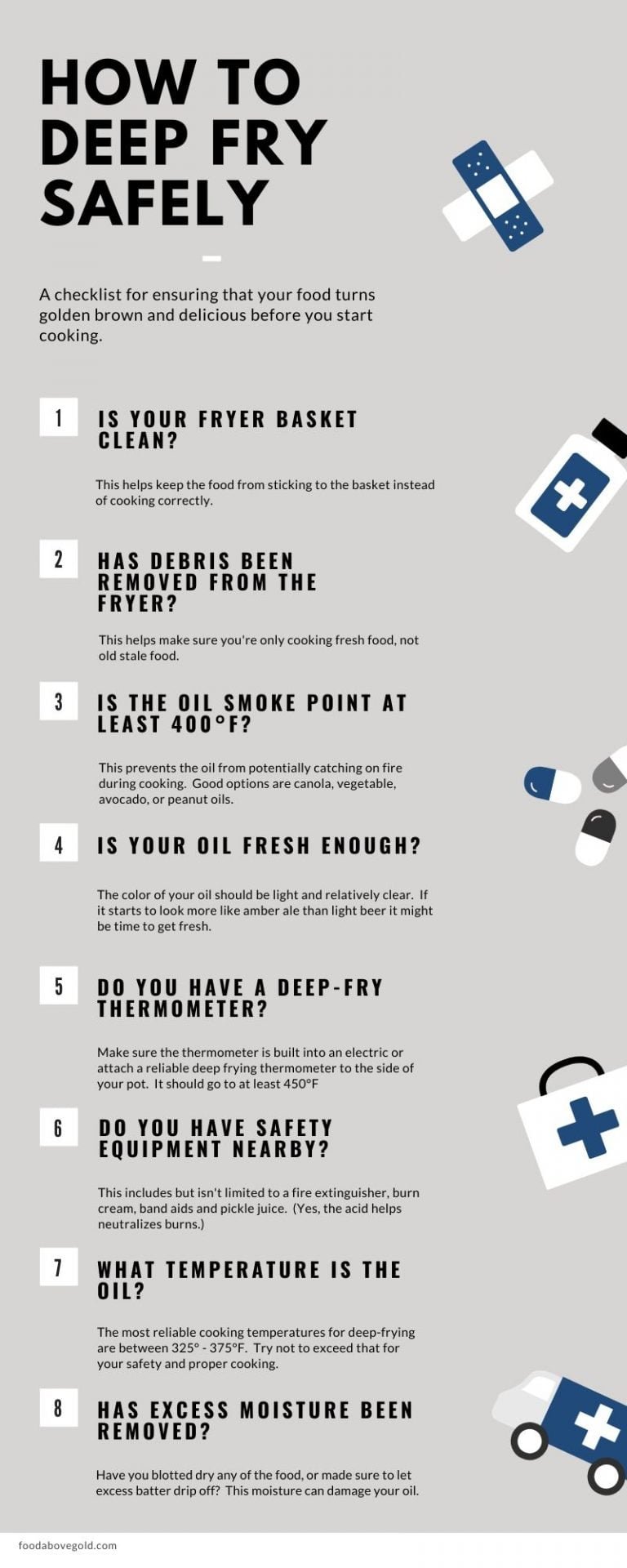
A Simple Deep Frying Temperature & Safety Checklist
A short checklist can make frying safer and more consistent. Use it before every frying session, especially when cooking a large batch or using a new appliance.
The best safety routine is one you can repeat without thinking. Prepare first, measure temperature, control the batch size, stay present, and clean up only after the oil has cooled.
- ✦ Before heating
Read the recipe and appliance instructions, prepare the food, check the oil level, and clear the cooking area.
- ✦ Before adding food
Confirm that the oil has reached the recipe’s target temperature.
- ✦ During frying
Add small batches, watch the oil temperature, and stay beside the fryer.
- ✦ For meat and poultry
Check internal temperature rather than relying only on color or cooking time.
- ✦ If oil smokes
Stop adding food, reduce or turn off the heat, and allow the oil to cool safely.
- ✦ If oil catches fire
Never add water. Turn off the heat if safe, cover a small pan fire with a suitable lid when possible, and evacuate and call 911 if the fire cannot be controlled safely.
- ✦ After frying
Turn off the heat, cool the oil fully before handling it, store reusable oil safely, and dispose of unwanted oil according to local guidance.