Pan weight matters because it affects how much heat the pan can store, how strongly its temperature changes when food is added, how quickly it responds to burner adjustments, and how easy it is to handle.
For cooks in the United States, the difference becomes noticeable when choosing between lightweight nonstick pans, stainless steel skillets, carbon steel, and heavy cast iron. A heavy pan can stay more stable when you add cold food, while a lighter pan can react more quickly when you raise or lower the burner. The best weight depends on the cooking job rather than on the idea that heavier automatically means better.
Pan weight is closely connected to thickness and material, but those properties are not interchangeable. A thick pan can have more thermal mass, while a highly conductive material can spread heat efficiently. Research published in the Journal of Cookery Science of Japan found that increasing pan bottom thickness slowed both heating and cooling, with the tested thick pans taking substantially longer to change temperature than thin pans. That trade-off explains why a substantial pan can be useful for searing but less convenient when you need rapid temperature control.
Source: Bing
What Does Pan Weight Actually Change?
Pan weight changes cooking mainly through thermal mass and handling. Thermal mass describes how much energy a pan can absorb and release as its temperature changes. When a heavier pan contains more material, it generally takes more energy to raise its temperature and more energy to make that temperature fall.
That becomes useful when cold or room-temperature food enters a hot pan. A pan with greater thermal mass can resist a sudden temperature drop, helping the cooking surface remain hot enough for browning. A lighter pan may lose temperature more quickly under the same disturbance, although its response to a burner adjustment can also be faster.
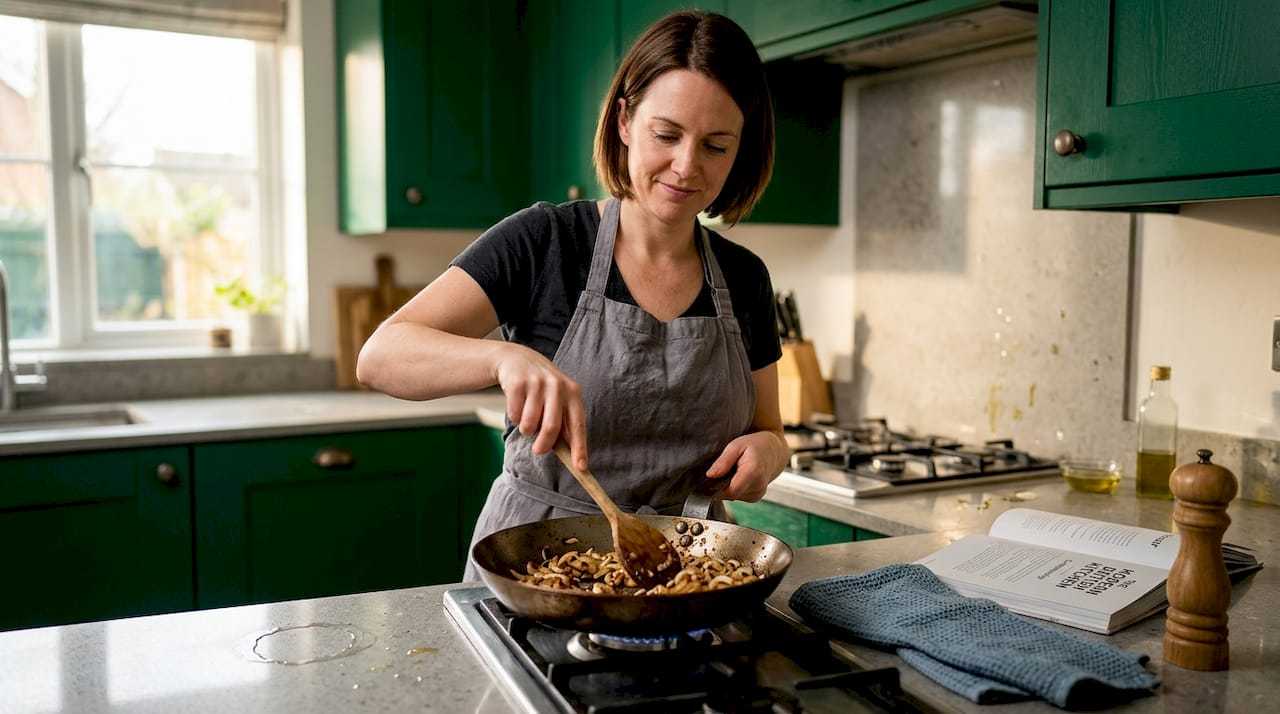
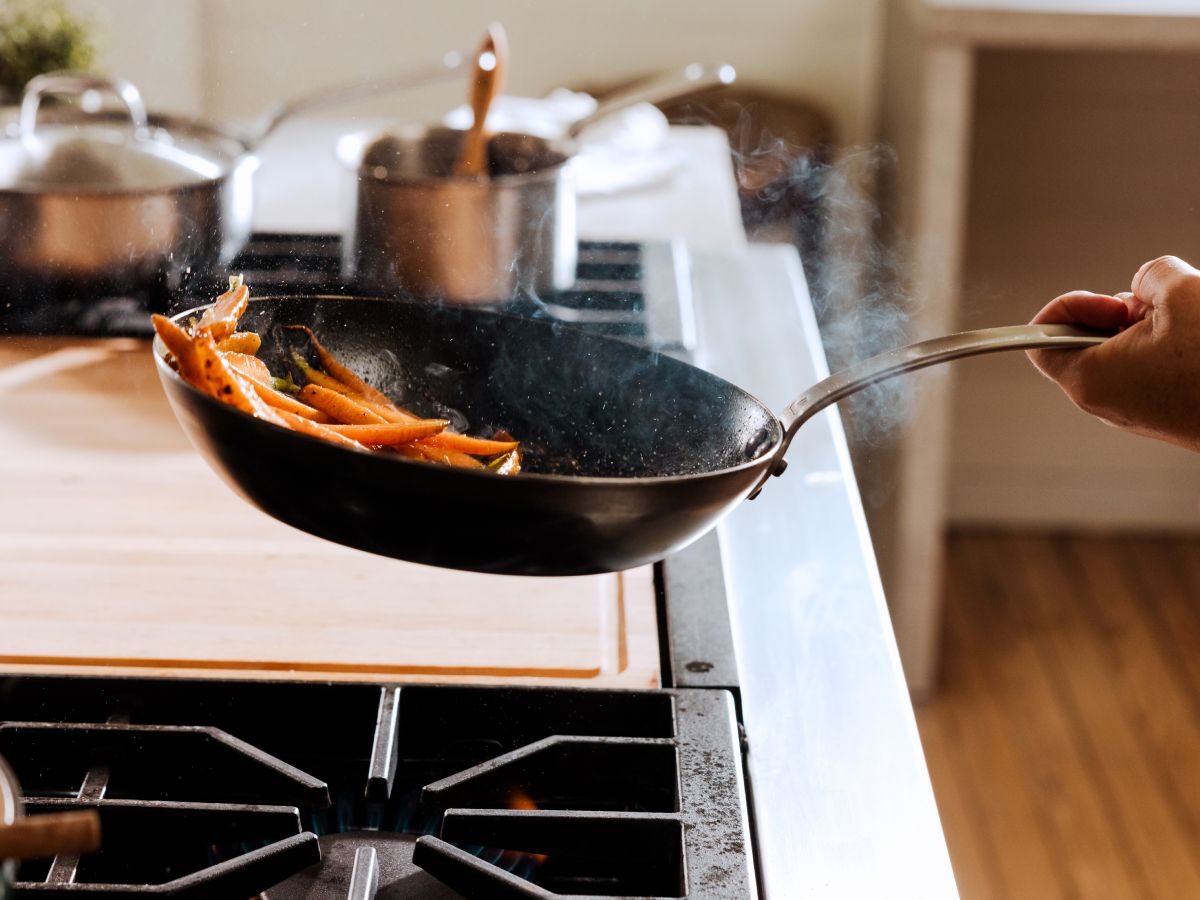
Weight also affects physical control. A 12-inch skillet filled with food can become considerably heavier than its empty specification suggests. The difference matters when you need to shake a pan, flip ingredients, move it from the cooktop to the oven, or lift it for draining.
Source: Bing
Heat stability
More thermal mass generally makes the pan less sensitive to short-term temperature changes caused by cold ingredients or brief burner fluctuations.
Temperature response
A heavier pan usually takes longer to heat and cool, so burner adjustments can take longer to show up at the cooking surface.
Handling
More weight can make tossing, flipping, lifting, and transferring cookware more demanding, especially after food and liquid are added.
Cooking consistency
A suitable amount of thermal mass can make browning and frying more predictable, but weight alone does not guarantee an evenly heated surface.
Weight Is Not the Same as Thickness
Two pans can weigh the same while putting their material in different places. One may have a thick base and relatively light walls, while another may use thick walls and a thinner cooking surface. For cooking performance, where the material is located can matter as much as the total weight.
This is why a pan’s construction should be considered alongside its listed weight. A heavy handle adds weight without adding thermal mass directly beneath the food. A thick base, by contrast, can place more material where heat enters and where temperature stability matters most.
Look at the base
A substantial, well-constructed cooking base can provide useful thermal stability without requiring the entire pan to be extremely heavy.
Check balance
A pan that balances naturally in your hand can feel easier to control than another pan with a similar total weight but poorly distributed mass.
Why Heavy Pans Hold Heat Better
A heavy pan can hold more thermal energy because greater mass generally means more material is available to absorb heat. Once thoroughly heated, that stored energy can help the cooking surface resist cooling when food is added.
This is particularly valuable when searing a steak, browning chicken, cooking burgers, or frying foods. These tasks benefit from maintaining a hot cooking surface because excessive cooling can slow browning and allow food to release more moisture before a crust develops.
The effect should not be exaggerated. A heavy pan does not create heat by itself, and it does not guarantee a good sear if it is overcrowded or insufficiently preheated. The burner, pan material, thickness, food temperature, moisture, and cooking technique all influence the result.
Source: Bing
Searing
High thermal mass can reduce the size of the temperature drop when cold meat contacts the pan, supporting more stable browning conditions.
Frying
A substantial pan can help resist temperature swings when food is added in batches.
Browning
Temperature stability can help maintain the conditions needed for browning rather than allowing the surface to cool dramatically.
Batch cooking
A heavier pan can be useful when cooking several portions, although overcrowding can still overwhelm the available heat.
Why Cold Food Can Expose a Lightweight Pan
Imagine two similarly sized skillets that are preheated to the same temperature. You add a large quantity of refrigerated vegetables or several cold pieces of chicken. The food absorbs heat from the cooking surface, so the pan temperature falls. The pan with greater thermal mass generally has a larger heat reserve and can resist that disturbance better.
That does not mean a heavy pan always cooks faster. A thin, highly conductive pan may heat quickly and transfer energy efficiently. The advantage of greater weight appears most clearly when the cooking process repeatedly removes heat from the pan.
Best use
Choose greater thermal mass when temperature stability is more important than rapid response.
Main limitation
A heavy pan can also remain hot longer than you want after the burner is reduced, so temperature corrections require more anticipation.
Heavy vs. Light Pans: Which Is Better?
Neither heavy nor light cookware is universally better. Heavy pans favor heat stability and are often well suited to searing and prolonged cooking. Lighter pans favor maneuverability and faster changes in response to the burner.
The most useful comparison is therefore not simply pounds or ounces. Consider what you cook most often, how frequently you move the pan, how much food you normally prepare, and how quickly you need the cooking surface to respond.
A home cook who mostly sears steaks and makes skillet meals may appreciate more thermal mass. Someone who frequently flips vegetables, sautés delicate ingredients, or makes quick sauces may prefer cookware that is easier to move and more responsive.
Source: Bing
Heavy cookware
Usually provides stronger thermal stability and can be especially useful for searing, browning, frying, baking, and longer cooking.
Medium-weight cookware
Often offers a practical compromise between heat stability and maneuverability for everyday cooking.
Lightweight cookware
Can be easier to lift and move and may respond more quickly to changes in burner power.
Cast Iron, Carbon Steel, and Stainless Steel
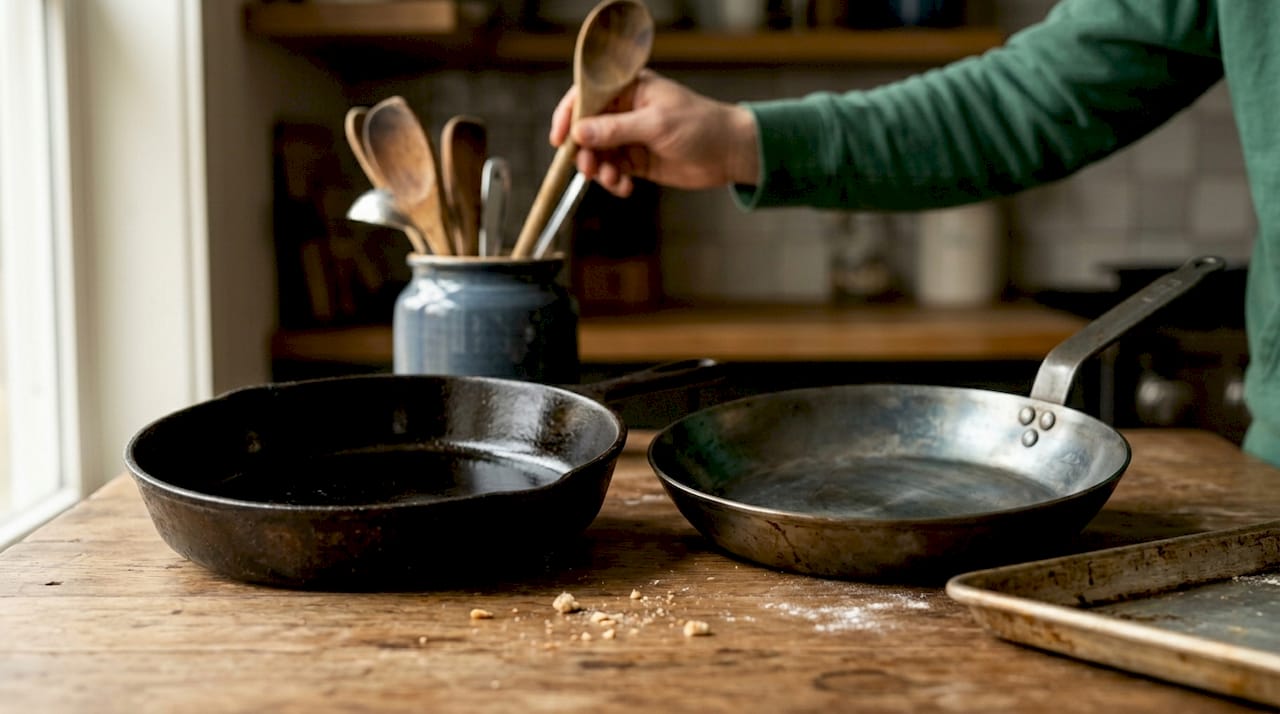
Cast iron is the classic heavy-pan example. Its substantial mass gives it strong heat retention, but its relatively low thermal conductivity means it can develop pronounced temperature differences if it is not adequately preheated. It also takes more effort to lift and maneuver.
Carbon steel generally provides a lighter alternative to cast iron while retaining many of the characteristics cooks want from a seasoned metal pan. Its exact behavior varies with thickness and construction, so a thin carbon steel skillet and a thick carbon steel skillet should not be treated as identical.
Stainless steel cookware varies widely because many modern pans combine a stainless cooking surface with aluminum or copper layers. A multilayer stainless pan can therefore be lighter than cast iron while still providing substantial heat-spreading ability. The construction matters more than the stainless label alone.
Cast iron
High mass, strong heat retention, slow response, and excellent suitability for many high-heat and oven-based tasks.
Carbon steel
Often offers a middle ground between cast iron’s thermal stability and lighter, more maneuverable cookware.
Stainless steel
Can range from relatively light to substantial, with layered aluminum or copper cores often used to improve heat spreading.
Pan Weight Does Not Guarantee Even Heat Distribution
One of the most useful distinctions in cookware is the difference between heat retention and heat distribution. A heavy pan can store a lot of heat while still having hot and cool areas across its cooking surface.
Heat distribution depends heavily on thermal conductivity, thickness, geometry, the construction of the base, and the heat source. Copper and aluminum spread heat efficiently compared with materials that conduct heat less readily, which is why they are commonly used as conductive layers in some cookware.
A 2000 study examining different pan materials and bottom thicknesses found relationships between temperature change, thickness, thermal conductivity, specific heat capacity, and thermal diffusivity. The researchers also reported that thinner or low-conductivity pans could produce less uniform bottom temperatures and were more prone to scorching under the tested conditions.
Source: Bing
Thermal mass
Describes how strongly the pan resists changes in temperature.
Thermal conductivity
Describes how effectively heat moves through the material and spreads from hotter areas toward cooler areas.
Thermal diffusivity
Describes how quickly a material’s temperature responds and spreads internally, combining effects related to conductivity, density, and heat capacity.
Construction
Determines where material is concentrated and how heat moves from the burner to the food.
Why a Heavy Pan Can Still Have Hot Spots
Consider a cast-iron skillet over a burner that is substantially smaller than the skillet’s base. The area directly above the burner receives concentrated energy, while the outer edges receive heat more indirectly. The pan’s mass helps stabilize temperatures, but it cannot completely eliminate the effect of burner size and material conductivity.
For this reason, moving to a heavier pan is not always the correct solution when food burns in the center while remaining pale at the edges. A better-matched burner, a different pan construction, lower heat, or more thorough preheating may address the underlying problem more effectively.
If the center burns first
Check burner size, heat level, pan construction, and heat-spreading ability before assuming the pan needs to be heavier.
If the whole surface cools quickly
Greater thermal mass may help, especially when cooking large amounts of cold food.
How Pan Thickness Changes Heating Speed
Pan thickness is one of the clearest reasons weight affects cooking. More material usually means more energy is required to produce the same temperature change. As a result, a thicker pan generally heats more slowly and also cools more slowly than a thinner pan made from otherwise comparable material.
The relationship has been demonstrated experimentally. In a study of five pan materials and different bottom thicknesses, thicker pans took two to five times longer to heat than thinner pans under the tested conditions. The study also found that increasing bottom thickness reduced the rate at which the pans cooled in air.
The practical trade-off is straightforward: thickness can provide temperature stability, but it can also reduce responsiveness. If you lower the burner because a sauce is getting too hot, a thick pan may continue delivering stored heat to the food for longer.
Source: Bing
Thin base
Usually changes temperature quickly, which can be useful for rapid adjustments but may allow larger temperature swings.
Thick base
Generally changes temperature more slowly and can provide greater thermal stability.
Very thick construction
Can be useful for high-temperature cooking and heat retention but may require more preheating time and anticipation when changing heat.
When Fast Response Is More Valuable Than Heat Retention
Rapid response can matter when cooking foods that move quickly from undercooked to overcooked. Delicate sauces, eggs, fish, vegetables, and other foods may benefit from cookware that responds promptly when the heat setting changes.
A responsive pan is also useful when you frequently move between high, medium, and low heat. Heavy cookware can still work for these foods, but the cook has to anticipate its thermal inertia and make adjustments earlier.
Sauces
Quick temperature response makes it easier to slow cooking before a sauce reduces too far or scorches.
Eggs and delicate foods
A responsive pan can make fine heat adjustments easier when gentle cooking is required.
Stir-frying and tossing
Lower weight can make repeated movement easier and reduce fatigue during active cooking.
How to Choose the Right Pan Weight for Your Cooking
Choose pan weight by matching thermal stability to the cooking tasks you perform most often. Do not start with a target number of pounds and assume that number will work for every material or pan size.
For a typical American home kitchen, a 10- to 12-inch skillet is a common size for everyday meals. As the pan gets larger, its total weight and the weight of a loaded pan increase, so handling becomes more important. A pan that feels comfortable empty may become difficult to control once it contains several servings of food.
Before buying, consider the pan’s empty weight, base construction, handle design, balance point, cooking surface, material, and compatibility with your cooktop. If possible, hold the pan as though you were sautéing or lifting it rather than judging it only from its specification sheet.
Source: Bing
For frequent searing
Favor a pan with enough thermal mass to resist major temperature drops when cold meat enters the cooking surface.
For sautéing and tossing
Favor manageable weight and good balance so the pan can be moved repeatedly without excessive effort.
For sauces
A moderately responsive pan can make temperature control easier, particularly when the cooking process requires frequent burner adjustments.
For oven cooking
A heavier pan can be useful for heat retention, but remember that the combined weight of the cookware and food must remain comfortable and safe to move.
For everyday versatility
A medium-weight, well-balanced pan with a substantial base is often a practical compromise between stability and maneuverability.
A Simple Buying Checklist
Use the following checklist when comparing two pans that appear similar. The goal is not to find the heaviest option but to determine whether the additional material actually improves the way you cook.
1. Compare size
A larger pan naturally requires more material and can become substantially heavier when loaded.
2. Check construction
Look for information about base thickness, layered construction, or the location of conductive materials.
3. Consider the cooking task
Searing and frying generally benefit more from thermal stability than delicate, rapidly changing cooking.
4. Test the balance
Hold the pan by its normal cooking grip and see whether the handle and pan body feel naturally balanced.
5. Account for food weight
Think about the combined weight of the empty pan, ingredients, liquid, and any lid you will need to move.
6. Match the cooktop
Consider burner diameter, induction compatibility, flatness, and how the pan’s base matches the heat source.
Signs That Your Pan Is Too Heavy for You
The practical test is comfort and control. If you struggle to lift the pan with food inside, avoid using one hand when two hands are appropriate. A pan that is theoretically excellent for heat retention is not a good fit if its weight prevents controlled cooking or safe movement.
A wok-flipping ergonomics study also found that wok size and handle angle significantly affected the maximum acceptable flipping weight among the experienced cooks tested. Although that study involved woks rather than ordinary skillets, it reinforces a broader point: weight cannot be evaluated separately from size, handle geometry, and the movement required.
Poor control
If you cannot comfortably tilt or reposition the pan when necessary, consider a lighter or better-balanced model.
Excessive fatigue
If normal cooking movements quickly become tiring, the pan may be heavier than your cooking style requires.
Difficult transfers
A pan that is hard to move safely from cooktop to counter or oven should not be treated as practical cookware for your kitchen.
Common Mistakes When Judging Pan Weight
The biggest mistake is treating weight as a universal measure of cookware quality. A heavier pan can be better for one task and worse for another. The same extra mass that helps maintain searing temperature can make a delicate sauce harder to control.
Another mistake is confusing heat retention with even heating. If food burns in one area and remains undercooked elsewhere, adding more mass may not solve the problem. Heat-spreading ability and pan construction deserve equal attention.
Finally, do not ignore the loaded weight. A skillet that weighs several pounds before cooking can become significantly heavier once filled with meat, vegetables, oil, or liquid.
Source: Bing
Mistake: Buying the heaviest pan available
More weight can increase thermal mass, but it also increases handling demands and may slow temperature changes.
Mistake: Assuming weight means even heating
Evenness depends strongly on material conductivity, construction, geometry, and the heat source.
Mistake: Ignoring thickness
Total weight does not tell you exactly how much material is located beneath the food or how the pan will respond.
Mistake: Ignoring the burner
A pan can perform poorly if its base size does not match the heat source, regardless of how heavy it is.
Mistake: Forgetting maneuverability
A pan that is difficult to lift, tilt, shake, or transfer may be impractical for frequent cooking.
What to Do If Your Pan Heats Unevenly
First check whether the burner is significantly smaller or larger than the pan’s cooking base. Next, reduce the heat if the center is becoming much hotter than the edges. Make sure the pan has been given enough preheating time when the recipe calls for a hot surface.
If the problem persists, inspect the pan’s construction and flatness. A heavier pan may improve temperature stability, but it will not necessarily correct poor heat distribution caused by low conductivity, unsuitable geometry, or an uneven base.
Check burner matching
Use a heat source that reasonably matches the pan’s base rather than concentrating all the energy in a small central area.
Adjust preheating
Give substantial cookware enough time to heat through instead of judging its performance immediately after turning on the burner.
Reduce excessive heat
More burner power does not automatically produce better cooking and can intensify hot spots.
Frequently Asked Questions
Q
Is a heavier pan always better for cooking?
No. A heavier pan generally provides more thermal mass, but it can also take longer to heat and cool and may be harder to maneuver. The best weight depends on the food, cooking technique, pan construction, and your ability to handle it comfortably.
Q
Does a heavier pan cook food more evenly?
Not necessarily. Weight can improve temperature stability, but even heat distribution depends strongly on thermal conductivity, thickness, geometry, base construction, and the heat source. A heavy pan can still have hot spots.
Q
Why are cast iron pans so heavy?
Cast iron cookware is made from a dense material and is commonly manufactured with substantial thickness. That gives it significant thermal mass and strong heat retention, but also makes it heavier and slower to respond to changes in burner power.
Q
Is a lightweight frying pan bad for searing?
Not automatically. A lightweight pan can sear successfully when it is properly preheated and used with appropriate heat and food quantities. However, a pan with greater thermal mass can resist temperature drops better when a large amount of cold food is added.
Q
Does pan thickness matter more than total weight?
For thermal performance, thickness and where the material is located can be more informative than total weight alone. A thick base puts material directly where heat enters the cookware, while additional weight in the handle does not contribute thermal mass beneath the food.
Q
What pan weight is best for everyday cooking?
There is no universal weight that works for every cook. For everyday use, prioritize a manageable pan with good balance, a well-constructed base, and enough thermal mass for the foods you cook most often. If you frequently sear, a somewhat heavier skillet may be worthwhile; if you frequently toss or flip food, easier handling may be more valuable.
✦ Wrapping Up
Conclusion
Pan weight matters because it changes the way cookware stores and releases heat and the way it feels during cooking. A heavier pan generally offers greater thermal stability, which can help when searing, browning, frying, and cooking large quantities of food. The trade-off is slower temperature response and greater physical effort.
The best cookware decision therefore goes beyond the number printed next to a pan’s weight. Consider thickness, material, thermal conductivity, base construction, burner size, pan diameter, handle balance, and the type of cooking you do most often. A well-balanced pan with useful thermal mass is usually more practical than simply choosing the heaviest option available.
💡 Key Takeaway
When comparing pans, choose enough weight and thickness to keep temperatures stable for your main cooking tasks, but not so much that the cookware becomes difficult to control, lift, or move safely.
Get microwave express cook tips, easy recipes, and time-saving hacks to speed dinner. Fast, tasty methods for busy nights—click for simple step-by-step ideas.
Stop the frustration and learn how to fix food sticking to stainless steel pans with heat control, oil timing, and quick seasoning tips for perfect results.
Compare gas stove vs electric stove for home cooking to see which saves energy, cooks faster, and fits your budget. Read our quick guide to choose smart.
Learn how Food Processor Meat & Protein Preparation works, including grinding meat, making protein recipes, safety tips, equipment choices, and best practices for home cooks.