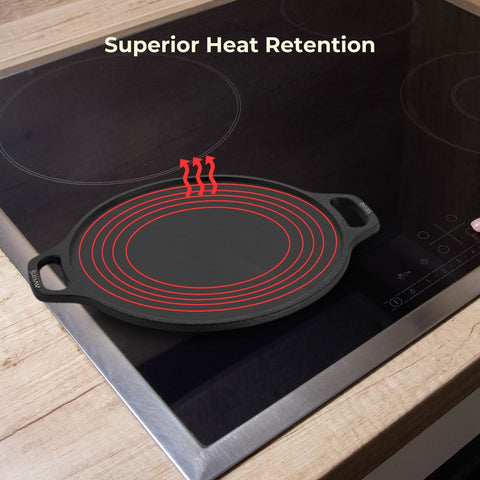
Cookware heat retention is the ability of a pan or pot to absorb heat and resist losing its temperature when food or a cooler ingredient is added. Heavy, high-mass cookware such as cast iron generally retains more heat, while lighter materials such as aluminum usually respond more quickly to temperature changes.
For home cooks in the United States, heat retention matters whenever a recipe depends on steady cooking temperatures, such as searing steaks, browning burgers, frying foods, or simmering a large batch of chili. A pan that loses a lot of temperature when cold food enters it may take longer to recover, while a pan with greater thermal mass can remain comparatively stable.
Heat retention is not the same thing as heat conductivity or heat responsiveness. A material can hold substantial thermal energy yet distribute heat slowly, which is one reason cast iron can retain heat well but still need careful preheating. The practical result depends on the cookware’s material, mass, thickness, construction, burner, food load, and cooking method.
Source: Bing
What Is Cookware Heat Retention?
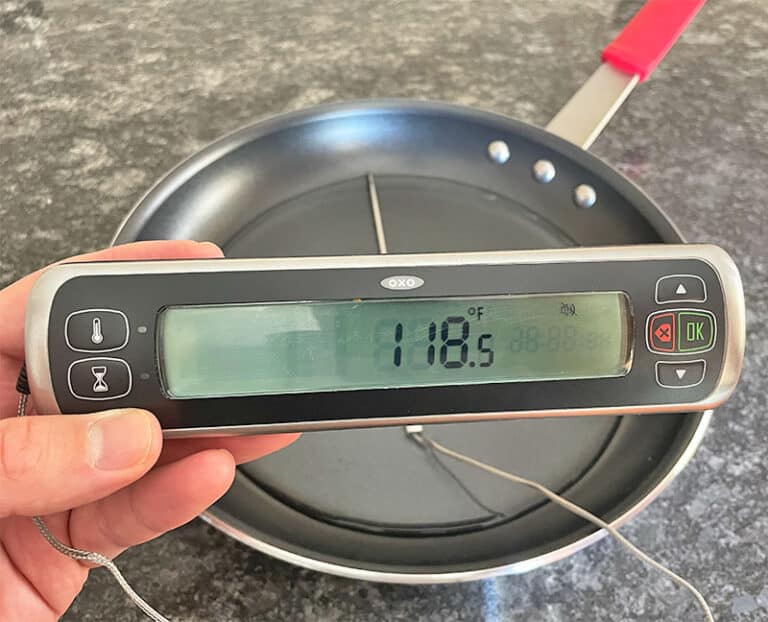
Cookware heat retention describes how well a heated pan or pot stores thermal energy and maintains its temperature as it loses heat to food, the surrounding air, or the cooking surface. In practical cooking, a pan with high heat retention experiences a smaller temperature drop when a relatively cool ingredient is added.
The amount of sensible heat stored in a material can be approximated with the relationship Q = m × c × ΔT, where Q is stored thermal energy, m is mass, c is specific heat capacity, and ΔT is the temperature change. This explains why cookware weight matters: increasing the mass of the heated material increases its ability to store heat at the same temperature.
Heat retention should therefore be considered separately from heat conductivity. Conductivity describes how readily heat moves through a material, while heat retention describes how much thermal energy the cookware can store and how quickly it loses that energy under particular conditions.
Source: Bing
Thermal mass
Thermal mass is the capacity of a cookware body to store thermal energy. More mass generally means more stored heat when the material is at the same temperature.
Heat conductivity
Thermal conductivity describes how readily heat travels through a material. High conductivity can improve heat spreading and responsiveness without automatically meaning high heat retention.
Heat responsiveness
Responsiveness describes how quickly cookware changes temperature when the heat source is increased or reduced. Lightweight conductive cookware can respond quickly, while heavy cookware usually changes more slowly.
Why Heat Retention and Heat Distribution Are Different
A pan can retain heat well without distributing that heat evenly. Cast iron is a useful example: it has substantial thermal mass, but its relatively low thermal conductivity compared with aluminum or copper means heat can spread more slowly across the pan. Preheating therefore matters.
Conversely, a highly conductive material can move heat quickly but may not store as much thermal energy if the cookware is thin and lightweight. This is why material, thickness, mass, and construction should be considered together rather than using material names alone as a shortcut.
Retention
How much thermal energy the cookware stores and how resistant its temperature is to change.
Distribution
How evenly heat moves across the cooking surface and through the cookware.
What Makes Some Cookware Retain Heat Better?
The biggest factors are mass, specific heat capacity, thickness, material, surface area, and how the cookware is constructed. A thick, heavy pan has more material available to absorb and store heat than a thin pan of the same diameter.
Density also matters because two cookware bodies with similar dimensions can contain very different amounts of material. Cast iron is much denser than aluminum, so a cast-iron pan can contain substantially more mass in a similarly sized piece of cookware.
Heat loss also depends on the conditions around the pan. A covered pot, for example, can lose heat differently from an uncovered skillet. Food temperature, food quantity, moisture, burner power, airflow, and contact with the cooktop all influence how quickly cookware cools.
Source: Bing
Mass
More cookware mass generally provides greater thermal storage at a given temperature.
Specific heat
Specific heat indicates how much energy is needed to raise a unit mass of a material by one degree. It contributes to the cookware’s total heat capacity.
Thickness
A thicker cookware body generally contains more material and can therefore have greater thermal mass, although construction and material still matter.
Construction
Clad cookware can combine materials with different thermal properties, using a conductive core to improve heat movement while retaining the durability and cooking characteristics of the exterior material.
Why a Heavy Pan Usually Recovers Better After Food Is Added
Imagine two skillets heated to the same starting temperature. If one contains substantially more thermal mass, adding a cold steak removes a smaller fraction of its stored thermal energy. The heavier skillet may therefore maintain a stronger cooking temperature while the food begins to heat.
This does not mean that every heavy pan will always cook better. Burner strength, pan geometry, preheating, food quantity, and material conductivity can change the result. A very heavy pan on an undersized burner may take longer to heat evenly in the first place.
Best use
High thermal mass is particularly useful when adding relatively cold or room-temperature food could otherwise cause a substantial temperature drop.
Trade-off
The same thermal mass that helps a pan stay hot can make it slower to cool or respond to a lower burner setting.
How Common Cookware Materials Compare for Heat Retention
Cookware materials balance heat retention, conductivity, responsiveness, weight, and durability differently. There is no single material that maximizes every property.
Cast iron is generally associated with strong heat retention because of its density and the substantial mass found in many cast-iron pans. Aluminum has much higher thermal conductivity and a higher specific heat capacity by mass, but many aluminum pans are comparatively light, so actual heat retention depends on how much material the cookware contains.
Stainless steel itself has relatively low thermal conductivity compared with aluminum and copper. Many stainless-steel pans therefore use aluminum or copper cores or layers to improve heat transfer. The resulting performance depends on the complete construction rather than the stainless-steel exterior alone.
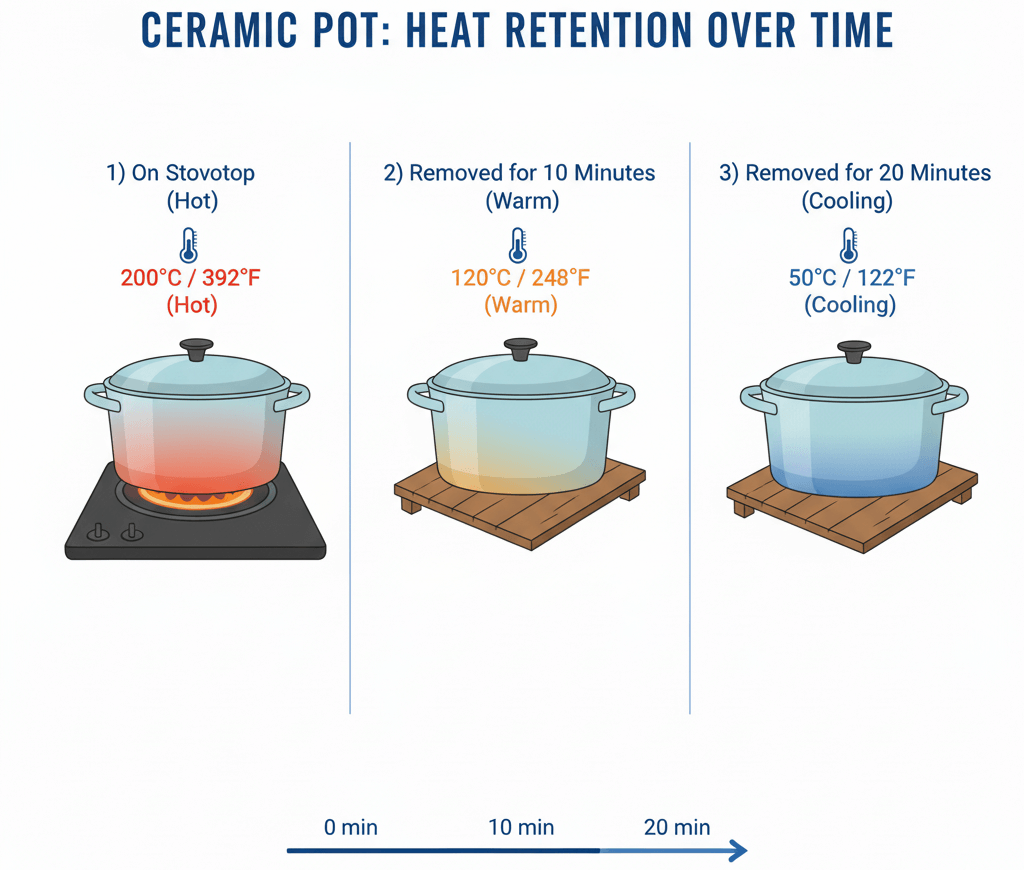
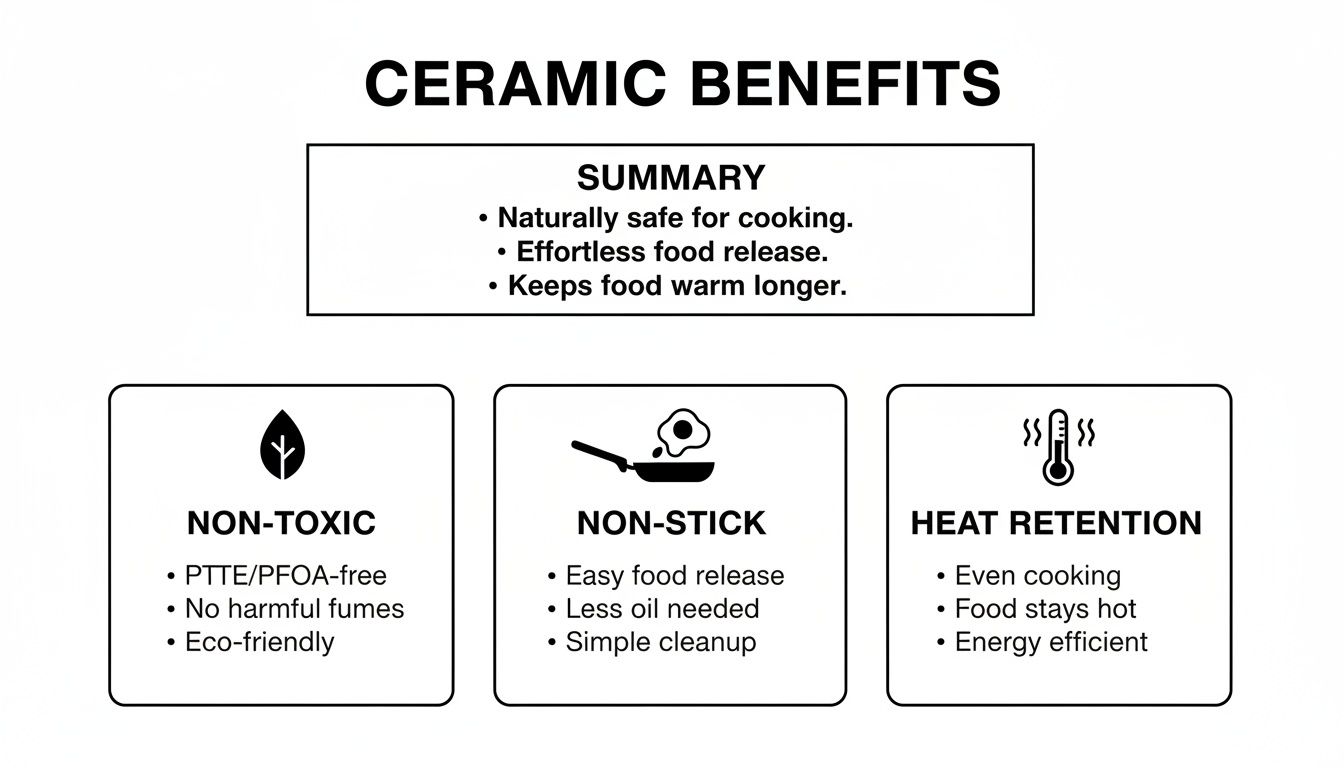
Ceramic cookware requires more careful terminology. Ceramic-coated cookware typically has a metal body underneath the coating, while solid ceramic cookware has different thermal characteristics. The construction and mass should be checked before assuming that the word ceramic predicts heat retention.
Source: Bing
Cast iron
Typically high thermal mass and strong heat retention, making it useful for searing, frying, and cooking where temperature stability matters.
Stainless steel
Stainless steel alone is not especially conductive, so many quality pans use layered aluminum or copper cores to improve heat distribution and responsiveness.
Aluminum
Highly conductive and generally responsive. A lightweight aluminum pan can change temperature quickly, while thicker or heavier aluminum cookware can retain considerably more heat.
Copper
Extremely conductive and highly responsive, making it useful when precise temperature adjustment matters. Heat retention still depends on the cookware’s mass and construction.
Ceramic
Thermal behavior varies substantially between solid ceramic cookware and cookware with a ceramic coating over a metal body. The underlying construction should be considered.
Cast Iron Versus Stainless Steel
Cast iron generally offers greater thermal mass in a skillet, while stainless-steel cookware is often engineered with conductive layers to improve heat distribution. For searing, cast iron’s ability to remain hot when food is added can be useful. For cooking that requires frequent temperature changes, a lighter or more conductive pan can be easier to control.
Neither material should be judged solely by heat retention. A stainless-steel pan with a thick aluminum core can distribute heat more effectively than a simple thin steel pan, while a cast-iron pan can perform well when properly preheated.
For strong temperature stability
Heavy cast iron is often advantageous when maintaining a hot cooking surface is a priority.
For responsiveness
Conductive, layered stainless cookware can offer a more responsive balance between heat spreading and temperature control.
Does Cookware Thickness Improve Heat Retention?
Greater thickness can improve heat retention when it adds meaningful material mass to the cookware. A thicker pan generally contains more material than a thinner pan of the same material and dimensions, so it can store more thermal energy at a given temperature.
Thickness can also influence heat distribution. In a multi-layer pan, the thickness and location of aluminum or copper layers can affect how quickly heat spreads. Simply making stainless steel thicker does not necessarily produce the same thermal behavior as adding a conductive core.
For shoppers, total construction is more useful than thickness alone. Look at the cookware’s material, weight, layered structure, base design, and intended cooking method rather than assuming that the thickest pan is automatically the best.
Source: Bing
Thicker can mean more thermal mass
When thickness adds substantial material, the cookware can store more heat and resist temperature changes.
Thicker is not automatically more responsive
Additional mass can make temperature changes slower, even when the cookware spreads heat effectively.
Layer placement matters
A conductive core located close to the cooking surface can influence heat spreading differently from simply adding more low-conductivity material.
Why Thin Pans Can Lose Temperature Quickly
A thin pan has less thermal mass available to absorb and store energy. When a large quantity of cool food is added, the food can draw heat from the pan faster than a relatively light pan can replace it from the burner.
This effect is particularly noticeable when overcrowding a skillet. Adding too much food at once can overwhelm the pan’s available thermal energy and the cooktop’s ability to supply replacement heat, reducing browning and encouraging steaming.
Small food load
A lightweight pan may perform adequately when the quantity and temperature of food are modest.
Large food load
A heavier pan can provide more thermal reserve when a large amount of cooler food is introduced.
How Heat Retention Affects Everyday Cooking
Heat retention is most noticeable when the cookware encounters a significant thermal disturbance. Adding refrigerated meat to a skillet, dropping frozen food into hot oil, or placing a large quantity of vegetables into a pan can all reduce the cooking surface temperature.
For searing, a pan with substantial thermal mass can help maintain a high surface temperature while the food begins to brown. For delicate sauces, however, a highly responsive pan may be easier to control because it changes temperature more readily when the burner setting changes.
For simmering and braising, a heavy pot can provide useful temperature stability, but the lid, food volume, burner setting, and liquid quantity often have as much practical importance as the cookware material.
Source: Bing
Searing
High thermal mass can help reduce temperature loss when cool meat contacts the cooking surface.
Frying
A heavy pot or pan can help stabilize oil temperature when food is added, although batch size and burner output remain important.
Sauces
Very high thermal mass can be less convenient when rapid temperature changes are needed, making responsiveness more valuable.
Braising
Heavy cookware can support steady cooking temperatures, especially when used with an appropriate lid and controlled heat.
How to Use Heat Retention to Improve Searing
Start with a properly preheated pan rather than relying on high heat alone. The goal is to bring the cooking surface to a suitable temperature before the food is added. With heavy cookware, allow more time for the pan to heat through.
Dry the surface of food when appropriate, avoid overcrowding, and use a burner that can supply enough heat for the pan and food load. If the pan becomes overloaded, even excellent heat retention cannot prevent a temperature drop indefinitely.
Preheat deliberately
Heavy cookware takes time to heat evenly, so rushing the preheating stage can produce an uneven cooking surface.
Avoid overcrowding
Adding too much food at once can overwhelm the available thermal energy and reduce browning.
Heat Retention Versus Heat Responsiveness
Heat retention and responsiveness are opposing priorities in many cooking situations. A high-mass pan can resist temperature changes, while a lightweight conductive pan can react quickly when the heat source changes.
Neither characteristic is universally better. If you are searing a steak, resisting a temperature drop may be valuable. If you are making a delicate caramel or sauce where small temperature adjustments matter, rapid response can be more useful.
The best cookware choice therefore depends on the cooking task. A kitchen that prepares many different foods may benefit from having both a high-thermal-mass pan and a more responsive pan rather than expecting one piece of cookware to excel at every task.
Source: Bing
Choose retention when
You want the cooking surface to remain comparatively stable after adding cooler food or when maintaining steady heat is central to the recipe.
Choose responsiveness when
You frequently need rapid changes in cooking temperature and want the pan to react quickly to burner adjustments.
Look for balance when
You need one versatile pan for searing, sautéing, sauces, and general cooking. Multi-layer cookware can combine useful conductivity with moderate thermal mass.
A Simple Way to Think About the Trade-Off
Think of thermal mass as a reservoir and responsiveness as the speed of adjustment. A large reservoir takes more energy to change but can supply more stored heat when the cooking process demands it. A small reservoir changes quickly but has less stored energy to draw on.
This distinction explains why a heavy cast-iron skillet can stay hot after the burner is reduced, while a thin aluminum pan can cool or heat much faster. The right behavior depends on what the recipe requires.
Stable temperature
Favor greater thermal mass when temperature stability after adding food is the primary concern.
Fast adjustment
Favor conductive, lighter cookware when immediate changes in heat level are more important.
Common Mistakes When Judging Cookware Heat Retention
The most common mistake is treating material names as complete descriptions of cooking performance. A thin aluminum pan and a thick aluminum pan do not have the same thermal behavior, just as a thin stainless-steel pan and a fully clad stainless-steel pan can perform differently.
Another mistake is confusing heat retention with even heating. A pan may stay hot while still having a hot spot above the burner. Heat retention does not guarantee uniform surface temperature.
It is also easy to assume that a heavier pan always cooks better. Weight can improve thermal stability, but excessive mass can make cookware harder to maneuver and slower to respond. The useful target is enough thermal mass for the cooking tasks you perform.
Source: Bing
Mistake: judging only by material
Always consider the cookware’s thickness, weight, construction, and core materials.
Mistake: confusing retention with even heating
A pan can retain heat well and still develop localized hot spots.
Mistake: assuming heavier is always better
Extra mass improves thermal stability but can reduce responsiveness and make cookware more difficult to handle.
Mistake: ignoring the burner
Cookware performance depends partly on the heat source. A large heavy pan may require adequate burner output to heat effectively.
When High Heat Retention Can Be a Disadvantage
High heat retention can work against you when a recipe requires rapid temperature reduction. A heavy pan may continue transferring substantial heat to the food after the burner is lowered or removed.
This is not inherently a flaw. It simply means the cook must account for stored heat. Moving the pan away from the burner, transferring food to another vessel, or adjusting the cooking process can be necessary when precise temperature control matters.
Delicate cooking
Recipes that require rapid temperature changes may benefit from cookware with lower thermal mass and high conductivity.
Carryover cooking
Food can continue cooking after the heat source is reduced because both the cookware and food remain hot.
How to Choose Cookware Based on Heat Retention
Choose cookware based on the temperature behavior your cooking requires rather than simply looking for the highest possible heat retention. For frequent high-heat searing, a substantial skillet can be useful. For delicate temperature control, a responsive conductive pan may be a better fit.
If you are buying one versatile skillet, consider a construction that balances thermal mass and conductivity. Fully clad stainless steel with an aluminum core, for example, is designed to combine the durability of stainless steel with improved heat transfer from the conductive inner layer.
For a dedicated searing or frying pan, heavier cast iron can be practical when its weight and slower response are acceptable. For everyday cooking that involves frequent temperature changes, a lighter pan may be easier to control.
Source: Bing
For steak and high-heat searing
Favor a substantial pan with enough thermal mass to limit temperature loss when food is added.
For delicate sauces
Favor responsive cookware that can react quickly when the heat source changes.
For general-purpose cooking
Consider balanced construction that combines useful heat distribution with moderate thermal mass.
For large batches
Consider cookware with sufficient size and thermal mass so the food load does not overwhelm the pan’s ability to maintain temperature.
A Practical Decision Table
The following comparison is a practical guide rather than a ranking. Actual performance varies with cookware thickness, construction, burner power, food quantity, and pan size.
Cast iron
Best suited to cooks who value strong heat retention and searing performance and do not mind substantial weight and slower temperature changes.
Clad stainless steel
Useful for cooks who want durability, heat spreading, and a balance between retention and responsiveness.
Aluminum
Useful when quick heat response and strong conductivity are priorities, especially in thicker or engineered constructions.
Copper
Useful when rapid heat response and precise control are more important than maximizing thermal mass.
Ceramic-based cookware
Evaluate the exact construction because solid ceramic and ceramic-coated metal cookware can have substantially different thermal behavior.
Frequently Asked Questions
Q
Which cookware has the best heat retention?
Heavy cast iron cookware is widely recognized for strong heat retention because its high density allows substantial thermal mass in a pan. However, the exact result depends on the pan’s mass, thickness, shape, starting temperature, and cooking conditions.
Q
Does a thicker pan retain heat better?
A thicker pan often retains more heat when the added thickness means more cookware material and therefore greater thermal mass. Thickness alone is not enough to predict performance because material and construction also affect conductivity and heat distribution.
Q
Is heat retention the same as even heating?
No. Heat retention describes how much thermal energy cookware stores and how resistant it is to temperature loss. Even heating describes how uniformly heat is distributed across the cooking surface. A pan can perform well in one area and less well in the other.
Q
Why does cast iron stay hot for so long?
Cast iron cookware commonly has substantial mass and high density, giving it considerable thermal capacity. Once heated, that stored thermal energy is released relatively slowly compared with a lighter pan under similar conditions.
Q
Is high heat retention always better for cooking?
No. High heat retention is useful for searing, frying, and maintaining temperature when cool food is added. But cookware with high thermal mass can be slower to cool or adjust, which may be less convenient for delicate sauces and recipes requiring rapid temperature changes.
✦ Wrapping Up
Conclusion
Cookware heat retention comes down to how much thermal energy a pan can store and how quickly that stored energy is lost during cooking. Mass, material, specific heat capacity, thickness, construction, food load, and heat source all contribute to the result.
Heavy cast iron is a strong example of high thermal mass, while conductive materials such as aluminum and copper are better known for moving heat quickly and responding rapidly. Modern multi-layer cookware can combine different materials to balance these characteristics.
For most home cooks, the practical lesson is simple: choose heat retention when temperature stability matters, choose responsiveness when rapid control matters, and consider both when selecting versatile cookware.
💡 Key Takeaway
When comparing pans, do not judge heat retention from the material name alone. Check the cookware’s weight, thickness, construction, and intended cooking task, then match its thermal behavior to the recipes you make most often.
Explore Dirty Soda Recipes & Flavor Combinations with easy ratios, classic mixes, creamy add-ins, fruit flavors, tips, and FAQs for homemade dirty soda.