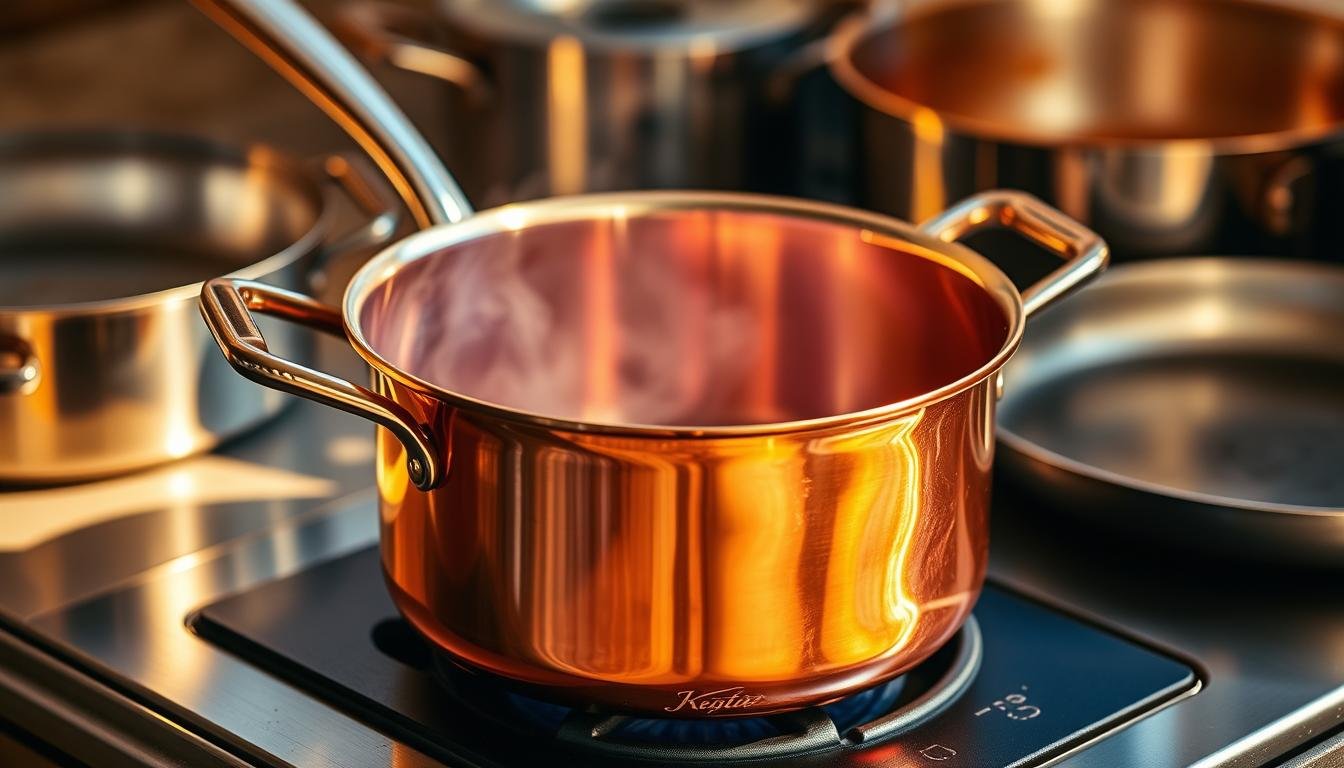
Cookware heat responsiveness describes how quickly a pan changes temperature when you increase, decrease, or remove the heat source. Highly responsive cookware, such as copper and thin aluminum, reacts quickly, while thick cast iron changes temperature more slowly and stores substantial heat.
For home cooks in the United States, heat responsiveness matters whenever a recipe depends on precise temperature control. It affects how quickly a skillet heats before searing a steak, how easily a pan responds when a burner is turned down, and how much residual heat remains after food is removed from the stove. A pan that reacts quickly is not automatically better; the useful choice depends on whether you need fast control, strong heat retention, or a balance of both.
Heat responsiveness comes from several properties working together. Thermal conductivity determines how readily heat moves through a material, while mass, thickness, density, and specific heat influence how much energy the cookware absorbs before its temperature changes. Construction also matters because many modern pans combine materials, such as stainless steel with an aluminum or copper core. That is why the label on the outside of a pan does not always tell you how it will behave on a burner.
Source: Bing
What Is Cookware Heat Responsiveness?
Heat responsiveness is the speed at which cookware changes temperature after the heat input changes. If you turn a burner from medium to high and the pan temperature rises quickly, the pan is relatively responsive. If you turn the burner down and the pan remains very hot for a long time, the cookware has greater thermal inertia and heat retention.
Responsiveness should not be confused with heat conductivity. Thermal conductivity describes how readily heat travels through a material. Responsiveness is a broader cooking behavior that also depends on how much material must be heated and how the cookware is constructed.
A useful simplified relationship is that the energy required to change temperature depends on mass and specific heat. In basic terms, more material generally requires more energy to produce the same temperature change. A thick, heavy pan therefore tends to respond more slowly than a thin pan made from the same material.
Source: Bing
Fast response
The cookware temperature changes relatively quickly when burner power changes. This is useful for delicate temperature adjustments.
Slow response
The cookware takes longer to heat or cool because more thermal energy is stored in the pan.
Heat retention
The cookware continues supplying heat after the burner is reduced or removed. High retention can stabilize cooking but can also make corrections slower.
Why Responsiveness Is Different From Heat Retention
A pan can conduct heat efficiently while still having substantial thermal mass. For example, copper has very high thermal conductivity, but a thick copper pan contains more material than a thin copper pan and therefore does not behave exactly like the thinner version. Conversely, a thin pan can change temperature quickly but may lose temperature rapidly when a large amount of cold food is added.
For cooking decisions, think about both properties: responsiveness determines how easily you can change the pan’s temperature, while retention determines how strongly the pan resists temperature changes and continues delivering heat.
Responsiveness
How readily cookware follows changes in heat input.
Retention
How much thermal energy cookware stores and continues releasing.
Which Cookware Materials Respond to Heat the Fastest?
Copper and aluminum are generally among the most thermally conductive common cookware metals, while stainless steel conducts heat much less readily. Published material-property data illustrate the difference: copper is roughly 390 to 400 W/m·K, aluminum roughly 237 to 240 W/m·K, and 304 stainless steel roughly 15 to 16 W/m·K under the stated reference conditions. These values help explain why cookware manufacturers often use aluminum or copper as conductive layers beneath or between stainless-steel surfaces.
However, material conductivity should not be treated as a direct ranking of complete pans. A thick copper pan, a thin aluminum pan, and a multilayer stainless-steel pan have different masses, thicknesses, geometries, and constructions. Those factors influence how quickly the cooking surface actually responds.
Source: Bing
Copper
Very high thermal conductivity makes copper capable of moving heat rapidly through the pan. It is valued when precise heat adjustment matters.
Aluminum
High thermal conductivity and relatively low density make aluminum capable of heating and cooling comparatively quickly, especially in thinner constructions.
Stainless steel
Stainless steel itself has much lower thermal conductivity than copper or aluminum. Multilayer cookware often adds conductive metals to improve heat spreading.
Cast iron
Cast iron is dense and commonly used in substantial thicknesses. Its mass gives it strong heat retention and makes temperature changes slower.
Carbon steel
Carbon steel can respond more quickly than a very thick cast-iron pan because it is commonly made thinner, while still providing useful heat retention.
Why Copper Is Highly Responsive
Copper transfers thermal energy very efficiently compared with common cookware metals. That high conductivity helps heat move from the burner-side surface toward the cooking surface and across the pan. The practical benefit is better control when the cook changes burner power.
Copper cookware is often lined with another material because bare copper can react with certain foods. The lining and overall construction therefore matter when evaluating a finished pan rather than the copper material in isolation.
Main advantage
Rapid heat transfer supports precise temperature adjustments.
Important limitation
The performance of finished copper cookware depends on thickness, lining, construction, and total mass.
Why Aluminum Is Common in Multilayer Cookware
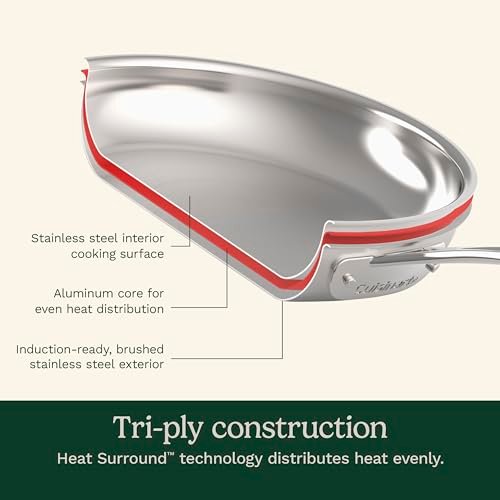
Aluminum combines relatively high thermal conductivity with low density, making it useful as a heat-spreading layer. A manufacturer can place aluminum between or beneath stainless-steel layers so the cooking surface benefits from faster lateral heat distribution while the stainless exterior provides different mechanical and cooking characteristics.
Heat spreading
An aluminum layer can help reduce large temperature differences across the cooking surface.
Construction matters
The amount, position, and thickness of aluminum affect how the finished cookware behaves.
How Thickness Changes Heat Responsiveness
Thickness changes responsiveness because thicker cookware usually contains more material that must absorb or release thermal energy. Holding the material and composition constant, increasing mass generally increases the energy required for a given temperature change.
Thickness also affects how heat travels from the burner-facing surface to the cooking surface. A highly conductive material can move heat through a thin wall quickly, while a thicker wall creates a longer conduction path. The result is a trade-off: thicker cookware can improve stability and reduce abrupt temperature swings, but it may take longer to react.
Source: Bing
Thin cookware
Usually changes temperature quickly but can also lose temperature quickly when cold food is added.
Thick cookware
Usually changes temperature more slowly and stores more thermal energy.
Thick conductive layers
Can improve heat distribution while adding thermal mass, so conductivity and responsiveness must be considered together.
Why a Heavy Pan Is Not Automatically Slow Everywhere
The phrase heavy pan describes mass, not a complete thermal behavior. A heavy pan made from a highly conductive material can distribute heat effectively, while a heavy pan made from a less conductive material may develop larger temperature differences during heating. Geometry, burner contact, construction, and material properties all contribute.
For this reason, comparing cookware only by weight can be misleading. When temperature control matters, look at the material combination and construction as well as total mass.
Weight tells you
How much material you are heating and moving.
Construction tells you
Where conductive materials are positioned and how heat moves through the pan.
How Cookware Construction Affects Heat Response
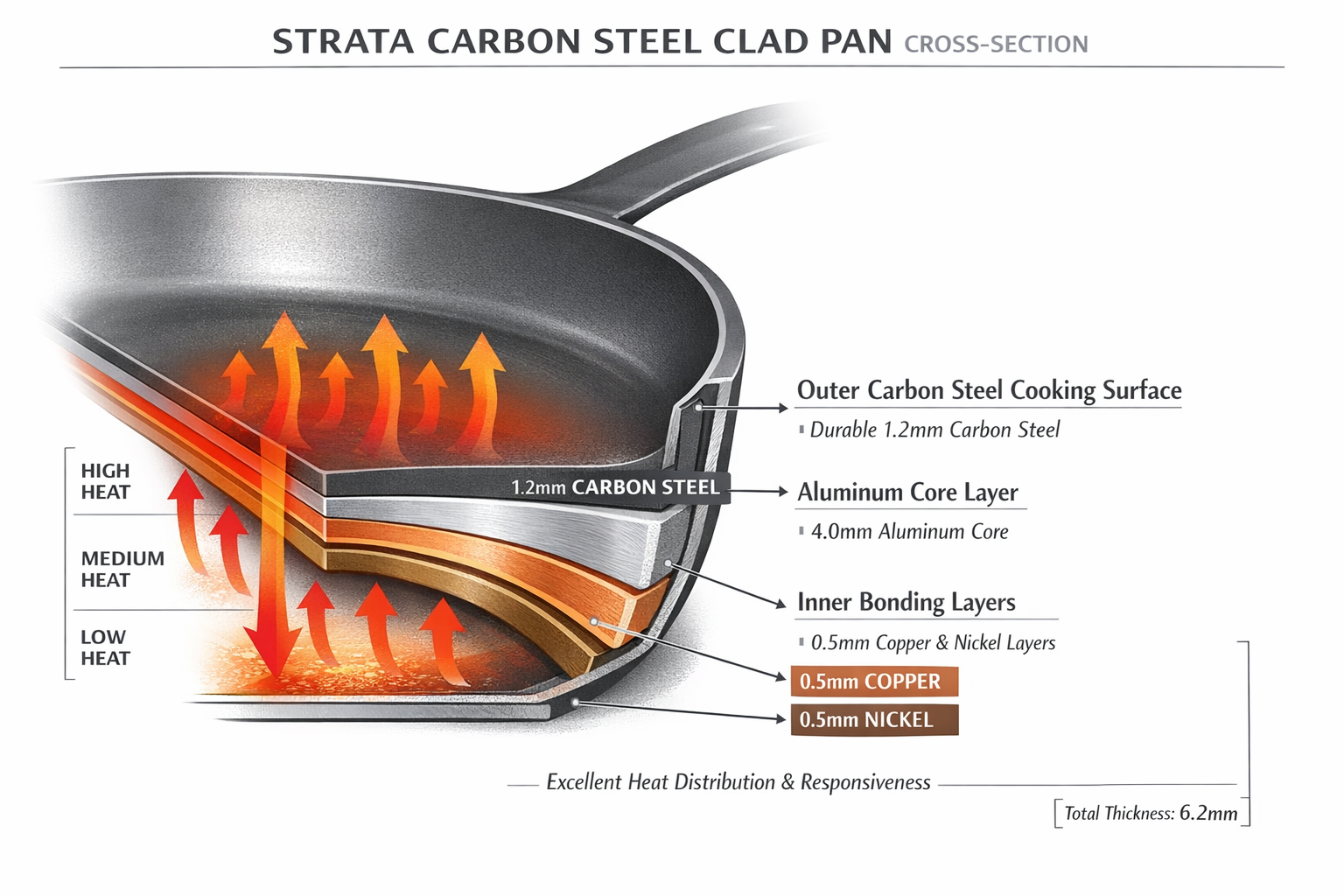
Modern cookware often combines several metals rather than relying on one material. A stainless-steel cooking surface may be bonded to aluminum or copper, creating a pan whose exterior material and thermal behavior are not the same thing.
Clad construction can spread heat more effectively than a poorly conductive single-metal design. The number of layers is less important than what those layers are made of, how thick they are, and where they are located. A pan with a conductive core can respond differently from a pan with only a conductive disk attached to the bottom.
Source: Bing
Fully clad construction
Conductive material extends through much or all of the cookware body, allowing heat to spread beyond the base.
Encapsulated or disk base
A conductive layer is concentrated near the bottom, which can improve burner heat distribution but may not spread heat through the sidewalls in the same way.
Single-material construction
The pan’s thermal behavior is more directly tied to the conductivity, mass, thickness, and geometry of that material.
Why Multilayer Cookware Can Be a Useful Compromise
Multilayer cookware can combine a durable or food-compatible surface with a more conductive internal layer. Stainless steel is frequently paired with aluminum or copper because the added conductive layer can help spread heat more effectively than stainless steel alone.
The trade-off is that additional layers can add mass and manufacturing complexity. A multilayer pan should therefore be evaluated by its actual construction rather than simply by the number of layers advertised.
Potential benefit
Better heat distribution while retaining the properties of the exterior cooking surface.
Potential trade-off
More material can increase thermal mass and affect how quickly the pan changes temperature.
Heat Responsiveness of Common Cookware Materials Compared
The most useful comparison is not simply which material heats fastest. Instead, consider how quickly each material responds, how evenly it distributes heat, how much heat it stores, and what type of cooking benefits from those characteristics.
The table below describes general behavior. Actual cookware can differ substantially because thickness, construction, burner type, and pan size change the result.
Source: Bing
Copper
Generally very responsive because of high thermal conductivity. Well suited to cooking where rapid temperature adjustment is valuable.
Aluminum
Generally responsive and effective at spreading heat. Commonly used as a conductive layer in cookware.
Stainless steel
The steel itself conducts heat relatively poorly compared with copper and aluminum. Construction with a conductive core can substantially change performance.
Carbon steel
Often offers a middle ground because cookware is commonly thinner than cast iron while retaining useful thermal mass.
Cast iron
Usually slower to change temperature because of its mass and thickness, but it stores and releases substantial heat.
Which Material Is Better for Different Cooking Tasks?
For sauces that require frequent burner adjustments, a responsive pan can make temperature control easier. For high-heat searing, a pan with strong heat retention can be advantageous because adding relatively cool food causes less dramatic temperature loss. For delicate foods, excessive retained heat can work against you if the pan remains hot after the burner is reduced.
The best choice therefore depends on the cooking task rather than on a universal ranking. A cook who frequently prepares custards, reductions, or delicate sauces may value responsiveness more than someone who primarily sears steaks or roasts vegetables.
Sauces and reductions
Responsive cookware can make rapid burner adjustments easier.
Steaks and searing
Strong heat retention can help the pan recover from the temperature drop caused by adding food.
Delicate foods
Fast response can help prevent continued cooking after the burner is lowered.
Stir-frying
Heat distribution and recovery both matter, particularly when ingredients are added in batches.
Heat Responsiveness and Different Stovetops
The same pan can behave differently depending on the heat source. Gas burners transfer heat through a flame and can be adjusted directly. Electric coil and radiant glass cooktops can continue delivering or retaining heat after the control is changed. Induction heats compatible cookware through electromagnetic energy and can change power rapidly, although the pan itself still has its own thermal mass and response time.
Cookware also needs good contact with the heating surface. A warped pan may heat differently from a flat one, and the size of the pan relative to the heating zone can affect where heat enters the cookware.
Source: Bing
Gas
The burner responds directly to the control setting, while the pan determines how quickly its temperature follows that change.
Electric radiant
The heating element and glass surface can retain heat, so reducing the control does not necessarily remove heat from the pan immediately.
Electric coil
The coil’s thermal behavior contributes to the overall response in addition to the cookware.
Induction
Power can be adjusted quickly, but cookware mass and construction still determine how rapidly the cooking surface changes temperature.
Why Burner Settings Are Not Pan Temperature
A burner setting controls heat input; it does not directly specify the cookware surface temperature. The actual temperature depends on the burner, cookware, food load, ambient conditions, and how much heat the pan is losing to its surroundings.
This distinction explains why two pans on the same burner setting can produce different cooking results. A heavy cast-iron skillet and a thin aluminum skillet can receive similar heat input while reaching and maintaining different temperatures.
Heat input
How much energy the cooking appliance supplies to the pan.
Pan response
How the cookware temperature changes as it absorbs, spreads, stores, and loses that energy.
How Food Changes the Pan’s Temperature Response
Cookware does not heat in isolation. Adding food changes the thermal balance immediately. Cold or room-temperature ingredients can draw energy from the pan, causing its surface temperature to fall. A pan with greater thermal mass can resist that change more effectively, while a lightweight pan may cool more noticeably.
Moist foods introduce another major effect. Water requires substantial energy to warm and can remove heat from the cooking surface as it evaporates. This is one reason a pan can behave very differently when empty compared with when it contains vegetables, meat, sauce, or a large quantity of liquid.
Source: Bing
Food temperature
Colder ingredients generally create a larger thermal demand when they are added.
Food quantity
A larger food load can cause a greater temperature drop because more material must be heated.
Moisture
Water absorbs energy during heating and phase change, which can substantially affect pan temperature.
Crowding
Overcrowding can reduce surface temperature and increase steaming because the pan must supply heat to more food and moisture.
Why a Pan Can Be Hot Before Food Goes In but Cool Afterward
A preheated pan has stored thermal energy. When food is added, energy flows from the hotter cookware into the cooler food. The surface temperature can therefore drop even though the burner setting has not changed. A pan with greater thermal mass generally has more stored energy available to absorb this disturbance.
Recovery depends on both the cookware and the heat source. A responsive pan can change temperature quickly when burner power changes, while a high-retention pan may provide stronger stability during the initial food drop.
Before adding food
The cookware temperature is determined mainly by the heat source, cookware properties, and heat losses.
After adding food
Heat transfers from the pan into the food, changing the thermal balance.
Common Mistakes When Judging Cookware Heat Responsiveness
The biggest mistake is assuming that the material name alone predicts how a finished pan will behave. A thin aluminum pan and a thick aluminum pan do not have identical thermal response, just as a thin carbon-steel skillet and a massive cast-iron skillet behave differently.
Another common mistake is treating heat distribution, responsiveness, and retention as interchangeable terms. They describe related but different properties. A pan can spread heat effectively yet respond slowly because it contains substantial mass.
Source: Bing
Mistake: judging by material alone
Correct the assumption by checking thickness, mass, and construction.
Mistake: assuming heavier means better
A heavier pan can provide stability but may be slower to adjust.
Mistake: confusing conductivity with responsiveness
Conductivity describes heat movement through a material; responsiveness also depends on thermal mass and construction.
Mistake: ignoring the stovetop
The heating appliance contributes to the overall temperature response.
Mistake: testing an empty pan only
Real cooking involves food, moisture, and heat losses that change the thermal behavior.
A Better Way to Compare Two Pans
Start by comparing the cookware’s material, thickness, construction, and approximate mass. Then consider the cooking task. If rapid adjustments are central to the recipe, prioritize lower thermal inertia and good conductivity. If temperature stability during searing is more important, stronger heat retention may be the better trade-off.
When manufacturer specifications are available, treat them as specifications rather than independent proof of real-world cooking performance. A construction diagram can tell you what materials are present, but actual cooking behavior also depends on burner power, pan geometry, food load, and technique.
Step 1
Identify the main materials and whether the pan is single-metal, clad, or disk-bottom construction.
Step 2
Compare thickness and mass rather than relying only on the material label.
Step 3
Match responsiveness and retention to the cooking technique you use most.
Step 4
Consider your stovetop and the size of the cooking zone.
Frequently Asked Questions
Q
What cookware is the most heat responsive?
Copper is generally among the most heat-responsive common cookware materials because of its very high thermal conductivity. Thin aluminum can also respond quickly. However, the responsiveness of a finished pan depends on thickness, mass, construction, and the heat source, so material alone does not determine the result.
Q
Is cast iron responsive to heat?
Cast iron can respond to heat, but thick cast-iron cookware typically changes temperature more slowly than thin, highly conductive cookware because it has substantial thermal mass. Its strength is heat retention and temperature stability rather than rapid adjustment.
Q
Does thicker cookware heat more slowly?
Generally, increasing thickness increases the amount of material that must be heated, which can slow temperature changes. Thickness also increases the distance heat must travel through the cookware. The exact effect depends on the material, geometry, construction, and heat source.
Q
Why is aluminum used inside stainless-steel cookware?
Aluminum has substantially higher thermal conductivity than common stainless steel, so it can help spread heat through cookware. Manufacturers can combine aluminum with stainless steel to improve heat distribution while retaining stainless steel at the cooking or exterior surface.
Q
Is fast heat responsiveness always better?
No. Fast responsiveness is useful when you need precise temperature changes, but strong heat retention can be valuable for searing and other cooking methods where temperature stability matters. The better characteristic depends on the recipe and cooking technique.
✦ Wrapping Up
Conclusion
Cookware heat responsiveness is the result of thermal conductivity, mass, specific heat, thickness, construction, and the behavior of the cooking appliance working together. Copper and aluminum generally provide strong heat-transfer capability, while thick cast iron emphasizes heat retention. Stainless steel by itself is less conductive, which is why many stainless-steel cookware designs use aluminum or copper layers.
For everyday cooking in a U.S. kitchen, the most useful approach is to match cookware behavior to the task. Choose greater responsiveness when quick temperature adjustments matter, and favor stronger heat retention when maintaining a stable, hot cooking surface is more important. When comparing pans, look beyond the material name and consider thickness, construction, weight, stovetop compatibility, and the amount of food you normally cook.
💡 Key Takeaway
Before choosing cookware, decide whether your priority is fast temperature control, strong heat retention, or a balance of both. Then compare the pan’s material, thickness, construction, and mass rather than judging it from the material label alone.
Learn Pizza Oven Cleaning & Maintenance for wood, gas, and electric ovens. Follow safe cleaning steps, care tips, schedules, and troubleshooting advice.
Learn Cutting Board Care & Maintenance with simple tips for cleaning, sanitizing, oiling, drying, storing, and replacing wood, plastic, and bamboo boards.
Learn when to replace old kitchen items, spot safety risks, and refresh your space with smart swaps. Practical timelines and tips to save time and money.