Food Processing Fundamentals: Methods, Principles, Safety, and Modern Practices
Food processing is part of daily life in the United States. Milk is pasteurized, vegetables are frozen, bread is baked, meat is chilled, and canned foods are heat treated. Even simple foods can pass through several processing steps before they reach a kitchen table.
The goal is not always to make food more complex. In many cases, processing helps control harmful microbes, slow spoilage, protect nutrients, and make food easier to store. Good Food Processing Fundamentals focus on using the right process for the right food, while keeping safety and quality in balance.

What Are Food Processing Fundamentals?
Food Processing Fundamentals are the basic ideas used to turn raw farm products into safe, stable, useful, and appealing foods. Processing can be very simple, such as washing and cutting a vegetable. It can also be complex, such as producing a shelf-stable canned meal.
Most food processing starts with a raw material and a clear goal. A processor may want to remove dirt, control microbes, reduce water, change texture, extend shelf life, or make the food easier to transport. The process must match the food because heat, moisture, oxygen, and handling can affect each product in different ways.
A useful way to understand Food Processing Fundamentals is to view processing as controlled change. Each step should have a purpose, a safe operating range, and a way to check the result.

- ✦ Safety
Processing can reduce or control food safety hazards when the process is properly designed and monitored.
- ✦ Shelf life
Many processes slow microbial growth, enzyme activity, oxidation, or other changes that cause food to spoil.
- ✦ Quality
Good processing protects useful traits such as color, flavor, texture, aroma, and nutrient value.
- ✦ Convenience
Processing can make foods easier to cook, serve, store, transport, and use.
Processing Starts With Raw Materials
Raw material quality affects the final product. Fresh produce, milk, grains, meat, seafood, and other foods can vary in size, moisture, maturity, fat, protein, and microbial load. A strong process cannot always fix poor raw material quality.
For this reason, processors check incoming ingredients before production. Sorting, grading, cleaning, and inspection can remove damaged material and help create a more consistent starting point.
- ✦ Ingredient condition
Freshness, maturity, temperature, moisture, and physical condition can affect processing results.
- ✦ Consistency
More uniform raw materials make it easier to control time, temperature, moisture, and other process factors.
Unit Operations in Food Processing
A food factory often breaks production into smaller steps called unit operations. Examples include washing, cutting, mixing, heating, cooling, drying, filtering, filling, and packaging.
Each unit operation changes the food in a specific way. Looking at the process step by step makes it easier to find hazards, control quality, reduce waste, and improve production.
- ✦ Physical operations
Cutting, grinding, mixing, separating, filtering, and similar steps change the physical form of food.
- ✦ Thermal operations
Heating and cooling control temperature to achieve safety, quality, or shelf-life goals.
- ✦ Mass transfer operations
Drying, evaporation, and related methods remove or move water and other substances.
Why Is Food Processed?
Food processing serves several purposes. One of the most important is food safety. Raw foods can carry bacteria, viruses, parasites, toxins, allergens, or physical hazards. Proper processing and handling can help control many of these risks.
Another major goal is preservation. Fresh food can change quickly because microbes grow, enzymes remain active, and oxygen can cause chemical changes. Processing can slow these reactions and give food a longer useful life.
Processing also supports the modern food supply. Foods often travel long distances and may spend time in stores, homes, or distribution centers. A suitable process and package can help maintain quality during this journey.
- ✦ Microbial control
Processes such as pasteurization, cooking, refrigeration, and freezing can control the growth or survival of microorganisms.
- ✦ Preservation
Drying, canning, freezing, fermentation, and other methods can extend the useful life of food.
- ✦ Waste reduction
Processing can help preserve seasonal foods and make more raw material available for later use.
- ✦ Food access
Stable processed foods can be stored and transported more easily than many fresh foods.
- ✦ Convenience
Ready-to-cook and ready-to-eat products can reduce preparation time for busy households.
Processing Does Not Always Mean Highly Processed
The term processed food covers a very wide range of products. Washing an apple, freezing peas, milling wheat, pasteurizing milk, and making a packaged snack all involve processing, but they use very different methods.
The useful question is not simply whether a food is processed. It is better to ask what was done to the food, why it was done, and how the process affects safety, nutrition, quality, and the final product.
- ✦ Minimal processing
Examples include washing, cutting, chilling, freezing, and simple packaging.
- ✦ Preservation processing
Examples include canning, drying, pasteurization, and fermentation.
- ✦ Formulation
Some products combine many ingredients and processing steps to create a specific taste, texture, or function.
Major Food Processing Methods
Food Processing Fundamentals include many methods, and no single method works for every food. Processors select a method based on the food’s composition, target shelf life, safety needs, desired quality, equipment, and cost.
Some methods use heat. Others use cold, remove water, change acidity, or use microorganisms in a controlled way. Many commercial foods use more than one method because several small controls can work together.

- ✦ Heating
Cooking, pasteurization, blanching, baking, and sterilization use heat for safety, texture, flavor, or preservation.
- ✦ Cooling
Refrigeration slows many forms of microbial growth and chemical change.
- ✦ Freezing
Freezing greatly slows microbial activity and many chemical reactions while helping preserve food for longer storage.
- ✦ Drying
Drying removes water that microbes need for growth and can greatly extend shelf life.
- ✦ Fermentation
Useful microorganisms convert food components into acids, gases, alcohol, or other products under controlled conditions.
- ✦ Canning
Canning combines controlled heating with sealed containers to produce shelf-stable foods when a validated process is followed.
- ✦ Chemical preservation
Salt, sugar, acids, and approved preservatives can help control spoilage and maintain product quality.
Heat Processing
Heat is one of the most important tools in food processing. The required treatment depends on the food, target organism, package, acidity, and process design. Too little heat may fail to control a hazard, while too much heat can damage flavor, texture, color, or nutrients.
Pasteurization is designed to reduce harmful microorganisms to a safe level while causing less quality damage than more severe heat treatments. Commercial sterilization uses a more severe process to create products with much greater stability.
- ✦ Time and temperature
Both matter because microbial control depends on how much heat reaches the food and for how long.
- ✦ Product properties
Acidity, thickness, particle size, and composition can change how heat moves through food.
Cold Processing
Refrigeration and freezing do not make food permanently safe. They mainly slow microbial growth and other changes. Safe temperatures must be maintained during storage and transport.
Freezing can preserve many foods for long periods, but quality can still change. Ice crystals may damage cells, and repeated thawing and refreezing can reduce texture and quality.
- ✦ Refrigeration
Cold storage slows many spoilage reactions and the growth of microorganisms that prefer warmer conditions.
- ✦ Freezing
Freezing turns much of the available water into ice, slowing microbial activity and many chemical reactions.
Drying and Water Activity
Drying removes water from food. This can make a product lighter, easier to store, and less supportive of microbial growth. Common examples include dried fruit, jerky, powdered milk, and many dried ingredients.
Water activity is more useful than total water alone when studying food stability. It describes how available the water is for microbial growth and chemical reactions. Processors use it with other controls to design stable products.
- ✦ Air drying
Warm or moving air removes moisture from exposed food surfaces.
- ✦ Spray drying
A liquid is turned into small droplets and dried rapidly to make powders.
- ✦ Freeze drying
Frozen water is removed under low pressure, which can help preserve shape, aroma, and some quality traits.
Food Safety in Food Processing
Food safety is a core part of Food Processing Fundamentals. A safe process must consider biological, chemical, and physical hazards from the raw material stage through processing, packaging, storage, and distribution.
Microbial hazards can include harmful bacteria, viruses, and parasites. Chemical hazards may include cleaning chemicals, natural toxins, undeclared allergens, or residues. Physical hazards can include metal, glass, stones, or other unwanted objects.
Food safety does not depend on one step alone. Good hygiene, process control, equipment design, employee practices, temperature control, sanitation, testing, and records can work together to reduce risk.

- ✦ Prevent contamination
Keep raw materials, equipment, workers, packaging, and finished foods under controlled sanitary conditions.
- ✦ Control time and temperature
Use appropriate temperature limits and process times for the specific food and safety goal.
- ✦ Control allergens
Identify allergen ingredients and prevent unintended cross-contact through proper handling and sanitation.
- ✦ Verify the process
Use measurements, checks, records, and suitable testing to confirm that critical controls work as intended.
- ✦ Maintain traceability
Keep useful records that help identify ingredients, batches, processing steps, and distribution when a problem occurs.
HACCP and Preventive Food Safety
HACCP stands for Hazard Analysis and Critical Control Points. It is a preventive approach that identifies hazards and establishes controls at points where those hazards can be prevented, eliminated, or reduced to an acceptable level.
A HACCP plan is specific to the product and process. A processor should not copy a generic plan without reviewing the actual ingredients, equipment, process steps, hazards, and controls.
- ✦ Hazard analysis
Identify hazards that may reasonably occur at each relevant processing step.
- ✦ Critical controls
Set controls for steps where a significant food safety hazard needs active management.
- ✦ Monitoring
Measure the control often enough to know whether the process stays within its required limits.
- ✦ Corrective action
Define what to do when a process leaves its required control range.
Sanitation and Hygienic Design
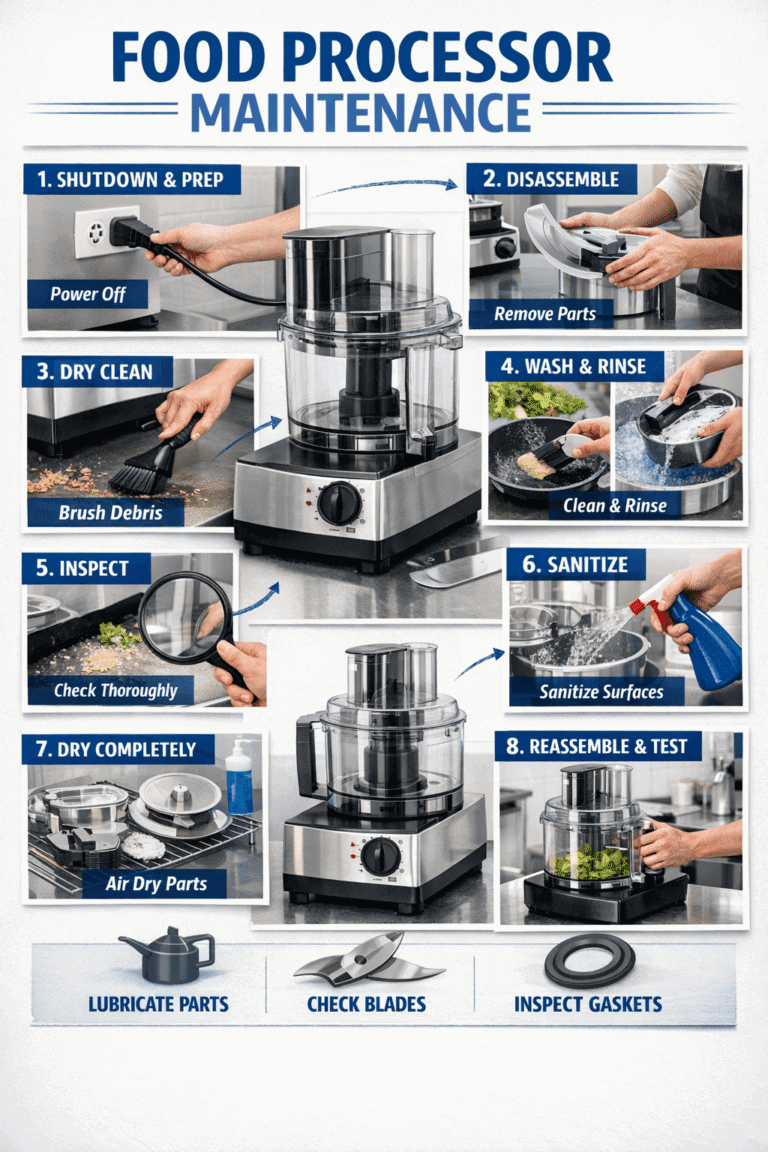
Clean equipment is essential, but good food safety design starts before cleaning begins. Equipment should be designed and installed so food does not collect in hard-to-clean areas and so cleaning and inspection can be done properly.
Sanitation programs should define what gets cleaned, how it is cleaned, how often it is cleaned, and how the result is checked. A clean-looking surface is not always proof that a sanitation process worked.
- ✦ Cleaning
Remove food soil and other unwanted material from equipment and surfaces.
- ✦ Sanitizing
Use an appropriate method to reduce microorganisms on cleaned food-contact surfaces.
- ✦ Verification
Use suitable checks to confirm that cleaning and sanitation procedures perform as expected.
How Processing Affects Nutrition, Flavor, and Texture
Food processing can improve some qualities while reducing others. Heating may improve safety and make some foods easier to digest, but intense or long heating can reduce certain heat-sensitive nutrients. Cutting and grinding can also expose food to oxygen and speed some changes.
Freezing often preserves many nutrients well, but texture can change because ice crystals affect plant and animal cells. Drying can concentrate nutrients by removing water, but the process can also affect heat-sensitive vitamins and flavor compounds.
Food Processsing Fundamentals therefore require a balance between safety and quality. The best process is not simply the strongest one. It is the process that meets the safety goal while causing as little unnecessary quality loss as practical.

- ✦ Nutrient retention
Time, temperature, oxygen, water, light, and processing intensity can affect nutrient retention.
- ✦ Flavor
Heating, fermentation, drying, and browning can create new flavors, while excessive processing may damage delicate aromas.
- ✦ Texture
Freezing, heating, drying, grinding, and mixing can change firmness, crispness, thickness, and mouthfeel.
- ✦ Color
Pigments can react to heat, oxygen, light, acidity, and enzymes during processing and storage.
The Role of Enzymes
Enzymes occur naturally in foods and can cause changes after harvest or during storage. They may affect color, flavor, texture, and nutrient stability. Blanching and other treatments can slow or stop some enzyme activity.
This is one reason food processors study the food itself rather than choosing a process from a simple list. The right control depends on the specific product and the change that needs to be managed.
- ✦ Enzyme control
Heat, cold, acidity, and other controls can reduce unwanted enzyme activity.
- ✦ Oxidation control
Limiting oxygen, light, and exposure time can help protect sensitive food components.
Balancing Safety and Quality
A processor must first meet the required food safety objective. Once that goal is secure, process conditions can be refined to protect flavor, texture, nutrients, appearance, and cost.
This balance is a practical lesson at the heart of Food Processing Fundamentals. A process that produces a safe product but poor quality may fail commercially, while a process that protects quality but does not control hazards is not acceptable.
- ✦ Safety first
Never reduce a validated safety control simply to improve a sensory trait.
- ✦ Optimize after validation
Quality improvements should stay within a proven and controlled safety process.
Food Processing Equipment and Process Control
Food processing equipment turns a process plan into a repeatable operation. Equipment may include mixers, grinders, pumps, heat exchangers, ovens, dryers, freezers, filling machines, conveyors, and packaging systems.
Equipment selection depends on the food and the process. A thin liquid moves and heats differently from a thick sauce. A soft fruit needs different handling from a hard grain. Good equipment must also support cleaning, inspection, maintenance, worker safety, and reliable measurement.
Process control is just as important as the machine itself. Temperature, time, pressure, flow, moisture, acidity, concentration, and other variables may need regular measurement.

- ✦ Temperature sensors
Sensors help track heating and cooling conditions and can support process verification.
- ✦ Flow control
Controlled flow helps maintain consistent residence time and product treatment in many continuous systems.
- ✦ Pressure control
Pressure can affect boiling, pumping, packaging, and other processing operations.
- ✦ Moisture measurement
Moisture and water activity measurements can help control drying and product stability.
- ✦ Calibration
Measuring devices should be checked and maintained so process decisions are based on reliable readings.
Batch Versus Continuous Processing
Batch processing treats a defined amount of food at one time. It can offer flexibility and work well for products made in different varieties or recipes. Many smaller food operations use batch systems because they can be easier to change between products.
Continuous processing moves food through a system at a steady rate. It can support high production volume and consistent conditions when properly controlled. The choice depends on product needs, scale, process design, and cost.
- ✦ Batch systems
Useful when recipes, product sizes, or production runs change often.
- ✦ Continuous systems
Useful when large volumes need steady and repeatable processing.
Why Process Records Matter
Records show what happened during production. They can include temperatures, times, batch numbers, ingredient information, equipment checks, sanitation records, and corrective actions.
Good records help a plant find problems early and investigate them later. They also support traceability and process verification.
- ✦ Consistency
Records help teams compare production runs and find changes in process performance.
- ✦ Traceability
Batch and ingredient records help identify affected products if a food safety or quality issue occurs.
Packaging, Storage, and Shelf Life
Food processing does not end when the product leaves the machine. Packaging and storage are part of the overall preservation system. A good package can protect food from oxygen, moisture, light, contamination, physical damage, and other causes of quality loss.
Shelf life depends on many factors. These can include water activity, acidity, temperature, oxygen, light, packaging, microbial stability, enzymes, and chemical reactions. A product may be safe but lose quality before it becomes unsafe, so processors often track both safety and quality.
For U.S. consumers, storage instructions on the package are important because a validated process does not protect food from every condition after opening. Refrigeration, freezing, clean handling, and proper storage time still matter at home.

- ✦ Barrier protection
Packaging can limit oxygen, moisture, light, or other factors that damage food.
- ✦ Package integrity
Seals, closures, and containers must remain intact when they are part of the safety or shelf-life system.
- ✦ Storage temperature
Keeping food within its required temperature range helps maintain safety and quality.
- ✦ Date information
Date labels can help communicate freshness or product quality, but consumers should also follow storage instructions and signs of spoilage.
What Determines Shelf Life?
Shelf life is the period during which a food remains within defined safety and quality limits under stated storage conditions. It is not controlled by one factor. A small change in temperature, oxygen exposure, moisture, or packaging can change how quickly a product deteriorates.
Processors may use shelf-life studies to understand how a food changes over time. Testing can examine microbial safety, taste, texture, color, aroma, chemical changes, and package performance.
- ✦ Microbial growth
Microorganisms can cause spoilage or create food safety risks under suitable conditions.
- ✦ Chemical change
Oxidation and other reactions can change flavor, color, nutrients, and aroma.
- ✦ Physical change
Moisture movement, crystallization, separation, and texture changes can reduce product quality.
Cold Chain Management
Some foods depend on continuous temperature control from processing through transport, retail, and home storage. This connected system is often called the cold chain.
A break in the cold chain can speed microbial growth or quality loss. Monitoring and quick action are therefore important for chilled and frozen products.
- ✦ Production
Cool products promptly when the process requires temperature control.
- ✦ Transport
Use suitable refrigerated or frozen conditions during distribution.
- ✦ Retail and home
Maintain proper storage temperatures after the product reaches stores and consumers.
Modern Food Processing and Sustainable Practices
Modern Food Processing Fundamentals go beyond basic preservation. Food companies also work to reduce water use, energy use, food waste, packaging waste, and production losses while keeping products safe and consistent.
New processing systems can sometimes reduce the need for intense heat or improve control over traditional methods. Examples include high-pressure processing, membrane filtration, improved drying systems, and automated process monitoring. Each technology has specific uses, costs, limits, and validation needs.
Sustainability should not be treated as a reason to weaken food safety. A better approach is to improve resource efficiency while keeping the required safety controls in place.
- ✦ Energy efficiency
Efficient heating, cooling, drying, refrigeration, and equipment operation can reduce energy use.
- ✦ Water efficiency
Better cleaning systems, reuse strategies where appropriate, and process optimization can reduce water demand.
- ✦ Waste reduction
Better yield control and use of suitable by-products can reduce the amount of food lost during production.
- ✦ Smarter monitoring
Sensors and automated systems can help operators spot process changes earlier and improve consistency.
Emerging Processing Technologies
Some newer technologies aim to preserve food while changing it less than certain traditional methods. High-pressure processing, for example, uses very high pressure rather than relying only on heat for selected products.
Other technologies use improved filtration, pulsed systems, controlled atmospheres, or advanced drying methods. These tools can be useful, but they still require careful product testing, process validation, equipment control, and food safety review.
- ✦ High-pressure processing
Uses high pressure to control microorganisms in suitable foods while helping retain some fresh-like qualities.
- ✦ Membrane filtration
Uses selective barriers to separate or concentrate components in liquids.
- ✦ Advanced automation
Uses sensors and control systems to track process variables and support repeatable production.
The Practical Lesson From Food Processing Fundamentals
The strongest lesson is simple: food processing is a system, not one machine or one step. Raw material quality, process conditions, sanitation, packaging, storage, testing, and human decisions all affect the final food.
When evaluating any food process, start with the goal. Define the hazard or quality problem, choose a suitable control, measure the important variables, verify the result, and document what happened. This approach makes Food Processing Fundamentals useful in both large plants and smaller food businesses.
- ✦ Define the goal
Know whether the process aims to improve safety, preservation, quality, convenience, yield, or several of these at once.
- ✦ Measure what matters
Track the variables that directly affect safety and product quality.
- ✦ Verify and improve
Review results, correct problems, and improve efficiency without weakening validated safety controls.